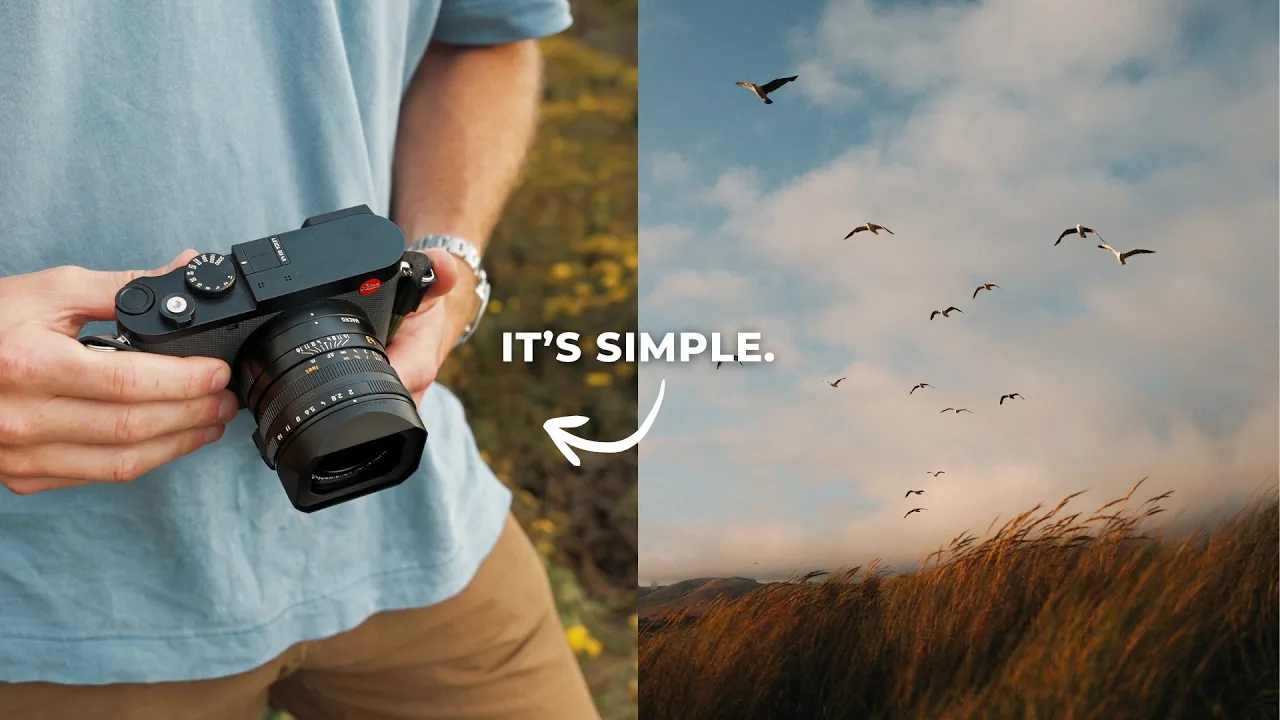
6 Tips That Made My Photos Better (How to Get Better at Photography)
Photography Basics
Ten years ago my photos were pretty bad. These six high-impact tips are what I credit most of my growth as a photographer to.
·
10 min read

Ten years ago, I was a complete photography noob. I had just started out and I was absolutely loving it, but I'm not going to sugarcoat it: my photos were pretty bad. Since then, I'd like to think my photos have gotten a lot better (hopefully you agree). I've been able to work with some of the world's biggest brands, and I've built a body of work I'm genuinely proud of.
I could give you a hundred tips on how to get better at photography. But I think a few of them are much higher impact than the rest, and those are the ones I want to focus on here. I credit a lot of my growth as a photographer to these, and if you do them too, I promise your photos will start getting better from day one. Let's go!
READ OR WATCH: This blog post is also available in video form! If you'd rather watch me explain this content, simply watch the video below. Otherwise you can find the text guide below. Just keep scrolling!
In My photos sucked... until I learned this., I walk through all six tips with photos from my own archive.
1. Curate and organize your photos
This first tip is something I thankfully learned early on, when I was shooting with some very talented photographers: curating and organizing your photos is just as important as shooting really good photos, and you need to take the time to do it right. You can shoot a ton of amazing images, but if you can't find them, or you can't recognize what actually looks good, you might be missing out on some of your best work.
It all starts with a rock-solid system you follow every time you shoot. Here's mine:
Come home, put the SD card in my computer, and import everything into a single folder in Lightroom.
Go through every single image I shot, whether it's 100, 1,000 or 5,000.
Mark the photos I want to delete with one star, and the photos I want to keep with five stars.
Delete all the one-star photos.
Do a second pass on the five stars, and give any real standout shots a red label.

Now, if I filter by red, I see all my best photos from that day of shooting. Not only does this save space on your hard drives (which will become an issue the longer you shoot, I promise), it puts all your best photos from a shoot in one place. If you come back five, six or seven years later, you know exactly where to look.
There have been so many times I've gone back through my archive and found absolute bangers I didn't think were that good when I shot them. A good example is some drone photos I shot in the Komodo Islands a few years ago. These photos are insane, and I'm so stoked I came across them, but I wouldn't have found them without organizing my photos in the first place.

And because I've grown so much as a photographer over the last five years, I can now recognize that they're good photos, which I couldn't at the time. So do yourself a favor and get a good organizational system in place, because later on you'll find images in your archive that are way better than you think they are now.
2. Consciously consume good work
If you can't recognize that a photo you shot is a banger, it'll just sit on your hard drive doing absolutely nothing. That leads me to the second tip: consciously consuming good work is crucial, both for developing your eye and for learning what you actually like to see in an image.
Yes, of course you need to go out and shoot to get better. That's the most important thing. If you're not shooting, you're not getting better. But consuming good work is a very close second.
And by consuming, I don't mean swiping through Instagram, liking photos and moving on. I mean sitting down with an image you find powerful and asking yourself: why do I like this? Is it the stylistic elements, the lighting, the colors, the composition, the subject matter? Or is it all of those things together, the story the image tells and the emotions you feel when you look at it? Do this slowly and consciously.

One of the ways I like to do this is with photo books. If there's a photographer I really like and they release a book, I'll buy it. It's nice to have at home, and when I have a little time before the gym or wherever, I'll open it up. A couple of my favorites right now are a book of film photos of everyday life in Greece, and On Valencia, a book of film photos shot in San Francisco. I'm from the San Francisco area, so it's nice to reminisce over these old school, nostalgic photos of where I grew up.
Consume your own work too. Don't just look at one of your photos and think, "Oh yeah, that's a banger." Ask yourself why it's a banger. One way I do this is by printing my photos. I have a Canon Selphy printer, and after every trip I print some of the images I shot. Putting them out in my room, where I can pick them up and look at them on a different medium throughout the day, away from my phone, is such a powerful way to get in touch with my own work.

I've also made a photography yearbook in the past, with all my best photos from 2021 in one place. It's not for sale. There's just one copy, which I show my friends and family, and it lets me sit down, slow down and take a better look at my images.

Honestly, I've gotten a lot better over the years because I pay attention to work I love and ask myself why I like it. Once you start to pick up on what you truly love in a photo, those things slowly work their way into your own work, and you'll be much happier with your images over time. This is also crucial for finding your own style, because if you don't know what you like in a photo, how are you supposed to create a style that's unique to you? (Here's how to find your photography style.)
3. Pay attention
This next tip is probably the simplest, but also probably the most important: pay attention. Every time you leave the house, even without a camera, pay attention to what you see and imagine how it would look in a photograph.
One of the things you'll learn as you grow is that 90% of photography is noticing beautiful things in the first place. The other 10% is actually clicking the shutter. If you can't identify something beautiful or interesting, you're probably not going to capture it at all.

This all comes down to vision, the way you see and interpret the world as a photographer. When you're just starting out, no offense, but your vision is probably going to suck. Mine did. So did the vision of all my favorite photographers. Your vision is a muscle you have to work and grow over time, and you do that by paying attention every day, no matter how simple the thing is: light spilling in through a window, or trees forming a natural frame around a landscape. It can be as simple as putting your hand out in really soft light and looking at how that light falls across it from one side to the other.

The more you do this, the more you'll recognize beautiful scenes you would have missed before. If you're a beginner and you ever shoot with a more experienced photographer, you'll see this firsthand. They'll notice things you didn't.
Carry an everyday camera. To take it one step further, carry an everyday personal camera with you every time you leave the house, and shoot absolutely anything. Simple or a grand banger, it doesn't matter. Having a camera with you and constantly thinking like a photographer is one of the best ways to train your vision. Mine is the Fuji X100VI (and before that, the X100V), but you don't need an expensive camera. A cheap camera or even your iPhone works, because image quality isn't the point. Noticing things is. (Here's my full take on the Fuji X100VI.)

4. Stop obsessing over sharpness and image quality
This next tip is for anyone who spends way too much time on sharpness or image quality, and thinks that if a photo isn't super sharp, it sucks. I hate to break it to you, but sharpness and image quality mean very little in the grand scheme of things.
Do you want your photos to be known for being sharp, or for being beautiful? There's a very big difference. A photo doesn't need to be sharp or have a ton of megapixels to be beautiful. Look at the greatest photos of all time. It's definitely not image quality that makes them so powerful, because a lot of them were shot on super old cameras with really old glass.
What makes them powerful is the story they tell: the combination of light, color, composition and subject matter, and how it all comes together into a story that stands the test of time. That's by far the most important thing.

When I was starting out, I was obsessed with sharp images. I watched all these videos about sharpness, export settings and megapixels. But over the years, I've realized I sometimes actually prefer photos that are less sharp, because they tell a more meaningful story. If your camera was made in the last 10 years or so and you spent at least a few hundred dollars on it, it's more than good enough to capture powerful images.
5. Unfocus your eyes
Fun fact: my vision absolutely sucks. Not my vision as a photographer, my actual eyesight. I'm very nearsighted, but I choose not to wear glasses, because I think it actually makes me a better photographer. Let me explain.
One of the biggest pitfalls beginners fall into is focusing so much on the details of a scene that they don't see the bigger picture. Because I can't always see all the details in front of me, I see the scene as a whole. It lets me break the scene down into shapes, light and color, and compose based on that.

So when you're out shooting, try unfocusing your eyes while you look at your composition. It breaks the scene down into its most fundamental building blocks, so you don't get sucked into the details. It's especially useful for composition, which is why I covered it in give me 15 minutes and I'll improve your composition too.

It works in the editing phase too. If you're struggling with the colors or contrast of an image, unfocus your eyes and look at it through a new lens, if that makes sense. I know it sounds a little gimmicky, but I promise it works.
6. Be okay with taking bad photos
It's hard to believe, but your favorite photographer on Instagram or YouTube takes terrible photos most of the time they go out and shoot. Myself included. If I go out and walk away with one absolute banger, that's a massive win for the day, and most of the time that's not even what happens. I'll shoot a thousand photos and I won't be happy with most of them, because as you grow, your standards keep rising until everything has to be spot-on: the light, the subject, the color, the composition.
This is just as important for beginners. If your standards are too high and you shoot a thousand photos that all suck, you'll probably feel pretty bad about yourself. But every bad photo is still teaching you what actually looks good, because if you can't recognize a bad photo, you can't recognize a good one either.

And if you want to shoot more good photos, you need to go out and shoot more. A lot of the time you won't get anything good, but the more you shoot, the luckier you get. That's especially true for street and landscape photography, which are so serendipitous and depend on things like the light and the people walking through your scene. You'll be shooting a sunset where everything lines up, and then boom, a cloud rolls in and your photo sucks. Or someone's standing in the perfect spot in a city, you get your camera up, and they walk away, and the shot is gone forever. Keep shooting anyway.
So, how do you get better at photography?
Those are the high-level tips I've picked up over the last 10 years as a photographer: organize your photos, consciously consume good work, pay attention, stop obsessing over sharpness, unfocus your eyes, and be okay with bad photos. By no means is this list exhaustive, but these are the ones I credit most of my growth to. If you want to keep going, check out the boring middle of photography.

Happy shooting!
Do you vibe with my style? Most of the photos in this post were edited with my Film Vibes Preset Pack, the same presets I use to edit pretty much all of my images. Check out the Film Vibes Preset Pack

Get the look in one click
Film Vibes Preset Pack
30 film-style presets that give your photos a timeless touch, inspired by famous film stocks.
$34
30 presets · For Lightroom
Sean Dalton
Made with ☕ and a camera.