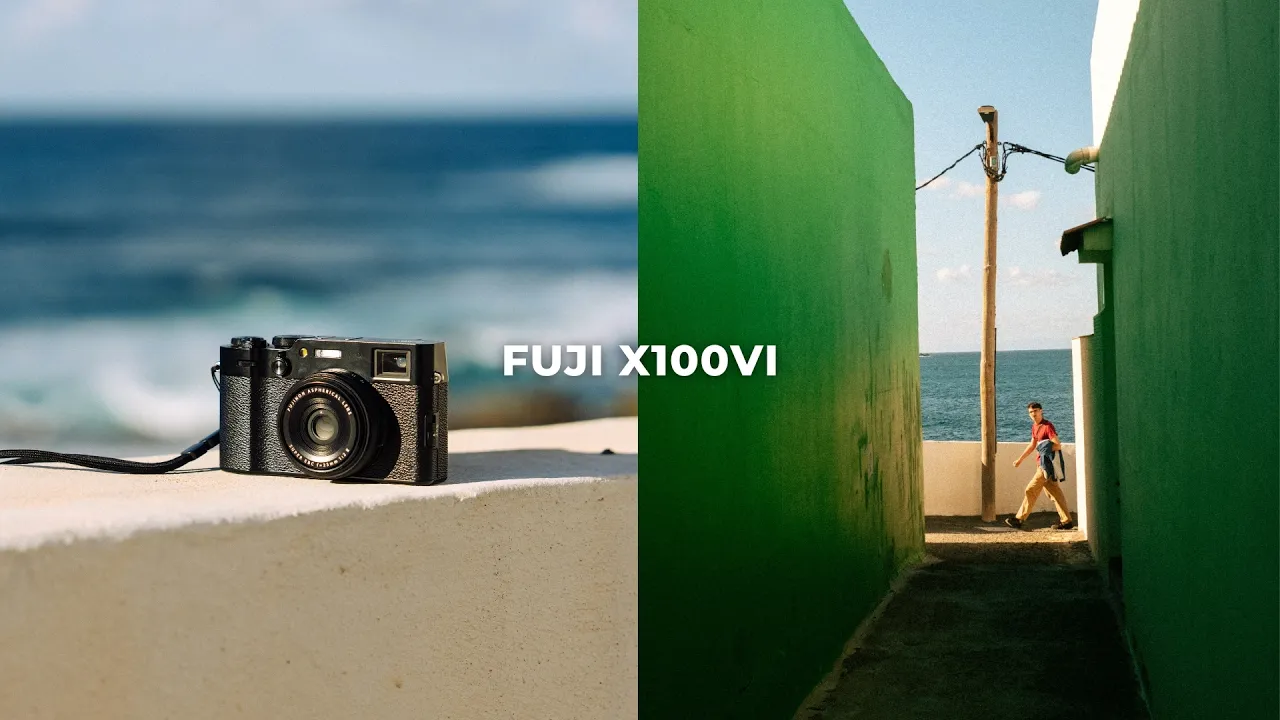
Is the Fuji X100VI the Perfect Travel Camera?
Gear
The Fuji X100VI might be the internet's favorite camera. I took it to Gran Canaria to find out if it's actually as good a travel camera as everyone says.
·
8 min read

The Fuji X100VI seems to be the internet's favorite camera. But is it really that good? I went to the north coast of Gran Canaria in Spain to investigate those claims, and more specifically, to figure out if the Fuji X100VI is as good a travel camera as everyone says it is.
Just so we're clear, I've had this camera for well over a year (since its release date), and I love it. But for me, it's served a very specific purpose: it's my everyday personal camera that I take with me to shoot my everyday life. For more serious photography or travel photography, I use my Sony, because that's the camera that doesn't get in the way and lets me capture anything I want.
Recently I got curious, though. Is the X100VI enough? If I went on a trip with only this camera, would I be able to capture the shots I want? I shot like crazy with it over a few days, both photos and video, and I definitely have some thoughts. Let's go!
READ OR WATCH: This blog post is also available in video form! If you'd rather watch me explain this content, simply watch the video below. Otherwise you can find the text guide below. Just keep scrolling!
In Is this the perfect travel camera?, I shoot the Fuji X100VI around Gran Canaria and share the photos from the trip.
What makes a good travel camera?
Before getting into the nitty-gritty of this specific camera, I want to talk about what actually makes a travel camera good. I think there are four key things to consider:
Size. Is it a camera you'll actually take on your trip, because it's small, fits in your bag and doesn't get in the way?
Image quality. Do the photos look good? If you shoot JPEG, do the JPEGs look good? If you shoot RAW, are the files easy to work with? And if you shoot video, how's the video quality?
Versatility. Can you use it in a ton of scenarios? Is it good for landscapes, street photography and portraits? How many situations can you legitimately use it in?
The fun factor. This might be the most important one. How fun is it actually to shoot with? Is it a camera you reach for because you absolutely love using it?

Size: it's perfect for travel
It was so bright out there that I was getting absolutely cooked by the sun (and I forgot my sunglasses). But the X100VI looked absolutely stunning, and its size is the first thing I want to talk about. I don't want to spend too much time on it, because it's pretty self-explanatory.
This is a camera you'd love to take on a trip. It's nice and small and it looks cool. You can throw it in a pocket, put it around your neck or hang it on your wrist. It's easy to carry and it doesn't get in the way. In that sense, it's perfect for travel photography.

That's exactly why I use it as my everyday personal camera. I can throw it in my little man purse and it hangs out with me no matter where I go, whether I'm going out or hanging with friends. But a good travel camera needs to do more than just be small and easy to throw in a bag.

Image quality: JPEGs vs RAW
The X100VI has incredible image quality. It has a beautiful sensor, the images are super sharp, and the lens is absolutely amazing. I think a lot of people love the X100 series because the image quality is so good.
It also shoots beautiful JPEGs. You can plug in a number of different film recipes, and I used to shoot this camera with JPEG recipes all the time. I thought they looked really good, and you get a great edited photo straight out of camera. But the more I've grown as a photographer, the more I've felt like Fuji recipes just aren't really my vibe. I like having a RAW edit.
So on this trip, I shot JPEG using the Portra 400 V2 recipe, and RAW at the same time. Here's the same photo both ways:

Left: the straight-out-of-camera JPEG with the Portra 400 V2 recipe. Right: the RAW file edited with my presets.
I typically find myself editing the RAWs with my preset pack, and I think they just look better. I like having the flexibility to actually edit an image. These RAW files don't have as much data as my Sony files, but I can still do a lot to them and edit them the way I like.

So based on size and image quality, it's an amazing travel camera so far. But there are a few more things to consider, and I do think there are a few shortcomings.
Versatility: the biggest shortcoming
The biggest shortcoming for me is that while this camera is incredibly versatile, it's not quite as versatile as a camera with interchangeable lenses.
I love the 35mm focal length. If you've watched any of my videos, you know I don't shut up about it, and I shoot with a 35mm prime on my Sony pretty much all the time. It's a super versatile focal length (here's how to shoot with a 35mm lens), and the X100VI has a 35mm full-frame equivalent lens, which I love.

But when it comes to travel photography, I like a little more versatility. I shoot all kinds of things: landscapes, street photography, portraits, food. And yes, a 35mm lens can do all of those things, but it doesn't necessarily excel at all of them. A camera that takes interchangeable lenses really opens up a lot of doors for travel photography, and that's exactly why I carry a Sony as my main travel camera and the Fuji as a backup.

Video quality. I almost forgot to mention video. The video quality is great too. I shot a little with it, not in F-Log, but using the same Portra 400 recipe I used for photos. I think it's cool that you can go on a trip and have your video look exactly like your photos. I do find switching between photo and video mode annoying, so I might need to move some settings around. But it's very capable as a hybrid camera. It's obviously not going to compete with my $6,000 Sony, but for most people it's more than enough to document your travels.
Autofocus: frustrating at times
The autofocus is something I've actually found quite frustrating with the X100VI. Most of the time it works pretty well. I use single shot autofocus, it focuses, and it's not a big problem. But if there's ever a plain white or plain black surface with no contrast, good luck focusing on that subject. That happened to me multiple times on this trip.
It's not a complete game changer, but it's pretty annoying, especially compared to my Sony, which just focuses immediately on whatever I point it at. It's super quick and stays out of the way, and that's something I really want from a travel camera. I don't want my camera getting in the way of my experience of travel.

The fun factor: it's undeniably fun
The last thing I want to talk about is the fun factor, and I can't deny it: despite all of its shortcomings, this camera is fun to shoot with. A big reason is that it's small and stays out of the way. But I also love the Fuji JPEGs. I think they're super relevant for a lot of people, and I love how easy it is to move photos from the camera to my phone and post them to my Instagram story. It's just a really simple, fun camera.

When a lot of people go traveling, that's exactly what they want. And for that reason, I think this is an incredible travel camera. The majority of people will be more than happy with it.

So, is the Fuji X100VI a good travel camera?
For most people, yes. But if you're really focused on photography (you want the versatility, the quick autofocus because you never want to miss a shot, the option to shoot with more lenses, and a full-frame sensor that's better in low light), then something like a Sony system will suit you better.
That's why, personally, I don't think I'll ever leave the Sony ecosystem as my main photography camera, especially for travel. Are Sony cameras sexy and fun to shoot like Fujis or Leicas? No, not in any way. But they stay out of the way and get the job done. As a photographer who wants to enjoy my trip and also capture certified bangers, nothing comes close to the Sony ecosystem for me.

But I absolutely love this camera. I use it in my day-to-day life, I've been using it for a long time, and I really enjoyed it on this trip. For a weekend trip with my partner, where we're just hanging out, going to dinner and walking around, it's perfect, and sometimes I do travel with only this camera. On a photography-focused trip, though, it's not the camera I use most of the time. That would be the Sony A1 II.
So if you're thinking about buying the X100VI and you're watching all the reviews trying to justify the purchase: just buy it. It's really cool, I really enjoy shooting with it, and it definitely serves a purpose in my setup. Even though I have a $6,000 camera, I still shoot with this thing all the time, because it's small, it shoots great JPEGs, and it does a lot of things better than the Sony does. (For the other end of the spectrum, here's my review of the Hasselblad X2D II.)
Happy shooting!
Do you vibe with my style? The RAW photos in this post were edited with my Film Vibes Preset Pack, the same presets I use to edit pretty much all of my images. Check out the Film Vibes Preset Pack

Get the look in one click
Film Vibes Preset Pack
30 film-style presets that give your photos a timeless touch, inspired by famous film stocks.
$34
30 presets · For Lightroom
Sean Dalton
Made with ☕ and a camera.