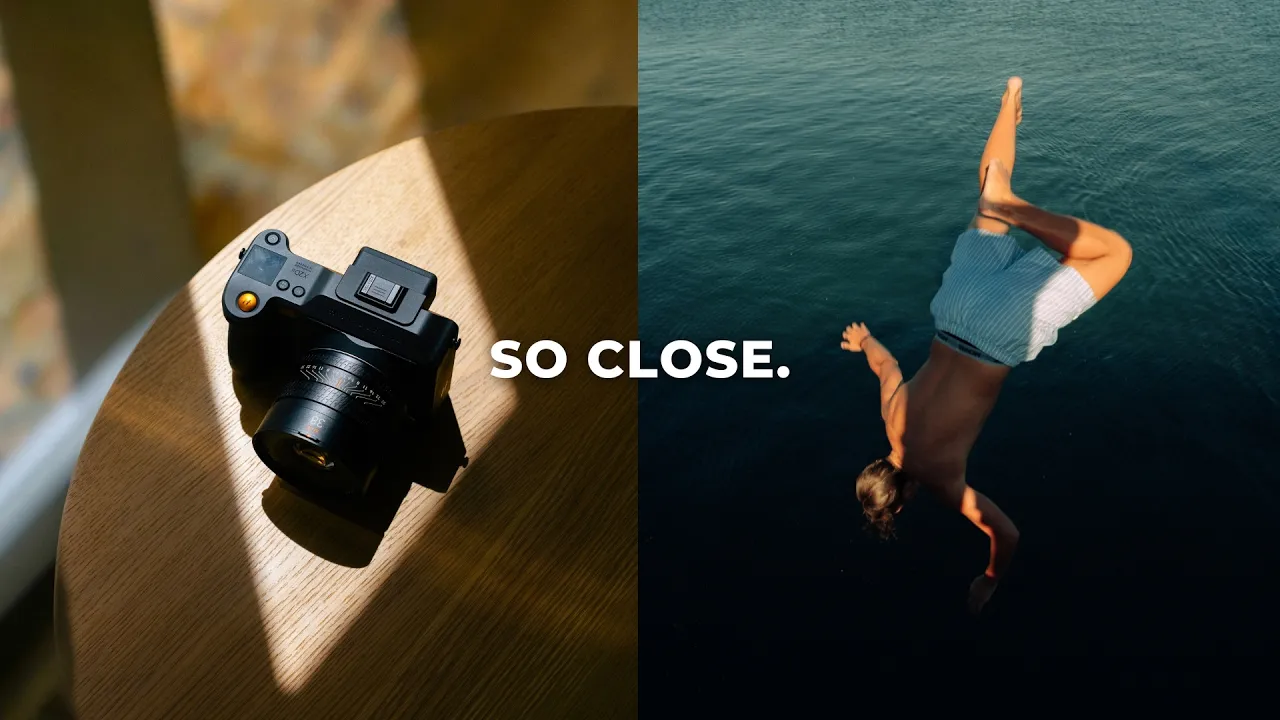
The Almost Perfect Camera: Hasselblad X2D II 100C Review
Gear
For the first time in years, I left my Sony at home. Here's what it was like shooting the Hasselblad X2D II 100C for a few weeks in Portugal, the good and the bad.
·
10 min read

There are a lot of great cameras out there, and I've had the privilege to shoot with many of them. But when it comes to a camera I actually use and rely on as a photographer, it really only needs to do one thing: stay the hell out of my way.
For the first time in many, many years, I came on a trip to Porto, Portugal, and left my Sony at home. I found a camera that not only stays out of my way creatively, but helps enhance it. So in this Hasselblad X2D II review, I'm sharing a ton of photos I shot with it over a few weeks in Portugal, plus the one upgrade that has me reaching for it more than my Sony recently.
My view on cameras is pretty simple. A camera is nothing more than a tool we use to translate our creative vision into a photograph. If anything about that camera gets in the way of the creative process, or creates barriers between you and your creative vision, it's a camera I just won't use. For years I've shot with my Sony system because it does that one thing incredibly well.
Quick disclaimer: Hasselblad gave me this camera in exchange for making the video this post is based on, but I have full creative control. So I'm going to talk about the good and the bad, and just my general experience shooting with it.
READ OR WATCH: This blog post is also available in video form! If you'd rather watch me explain this content, simply watch the video below. Otherwise you can find the text guide below. Just keep scrolling!
In The Almost Perfect Camera, I shoot the X2D II around Porto and Lisbon and show you the photos straight from the camera.
What I need from a camera
I think there are really three things that keep a camera out of my way and let me create with as little friction as possible.

Speed. The autofocus speed, and the general responsiveness of the camera.
Physical build. I don't want a camera that's too big, and I don't want one that's too small. I also want plenty of functional buttons I can use to enhance my shooting experience.
Image quality. The files have to be good. I want to be able to crop into them and edit them, and they need good color. I don't need the world's best image quality, but there's a certain level that has to be met for me to really use and rely on a camera.
Is the X2D II fast enough? (The autofocus upgrade)
Last year I made a video on the original Hasselblad X2D 100C, and I really enjoyed shooting with it. It had fantastic image quality, beautiful build quality, and it was just a fun camera to shoot. But it was a little too slow for my photography style. The responsiveness was sluggish, the autofocus was really lacking, and it didn't have continuous autofocus, so it missed on a lot of the things I value in a camera I'm going to rely on.
The X2D II feels like it's in a completely different world. There are a few small improvements:
A new joystick on the back to move your focus point around or reset it (which is how I have mine set)
A new custom button below the joystick
A rear screen that tilts back a little further
Slightly better dynamic range, going from 15 stops to 15.3 stops
Those are nice to have, but not essential. The biggest improvement by far is the autofocus. First off, we finally have continuous autofocus. I'm often shooting quickly and reactively on the streets, so I want to press a button and track a subject as they walk through the frame without losing focus, and continuous AF has been great for that. There are also more autofocus points and a new LiDAR autofocus system. To be honest, I don't really care about autofocus points or LiDAR. The only thing I care about is how functional the camera is.
And I've noticed a massive jump in autofocus performance, to the point where I can actually rely on this camera day to day, which I could not do with the Mark I. It feels a lot more responsive and snappy too. Now, I'm not saying it's at the level of my Sony for speed or autofocus. It's nothing compared to the Sony. But the X2D II does meet that minimum threshold of speed I need to rely on a camera every day.

I'll tell you one thing: Porto is an absolutely beautiful city. It was my first time there, and I was stunned by how gorgeous it is. It's incredibly old, so you get all these little medieval streets winding up into the hills, which creates some really dynamic shots you don't get in a modern city set on a grid. The light was a little harsh because it was the middle of August (here's how to shoot in harsh midday light if you're dealing with the same thing), but it's still a fantastic place to visit.

Build and ergonomics
Speed is just one of the three things, though. A fast camera with great autofocus isn't enough on its own, which leads me to the physical build. I don't think I need to say much here. This is a beautiful camera that feels incredibly good in the hand. Ergonomically speaking, I think the X2D series is one of the best on the market, with a really nice grip that's easy to hold.

This model also has some really nice button improvements that make the most important features easy to reach. I like having the little joystick on the back to move my focus point around, or press it to reset the focus point to the middle, which is what I typically like to do. I also set the new custom button to crop modes.
XPan mode. I love shooting with the crop modes on this camera, specifically the XPan mode. It creates some really interesting opportunities for creative photography, and I used it a lot in Porto to capture the skyline, the boats and the city as a whole. It looks really cool in that XPan format.

Small primes. I also like that the prime lenses are nice and small. I was shooting the 38V and the 55V, and they fit really nicely on the body. (More on the lenses below.)
The screen. The screen on this thing is absolutely incredible. It's big, it's bright, the colors look amazing, and I love being able to review my images in the field to make sure I got the shot.
In short, the build quality, ergonomics and functionality are top notch, some of the best in the business. So far, this camera is two for two.

Hasselblad X2D II image quality
That leaves the third thing, and of course that's image quality. Just like the Mark I, the image quality from this camera is absolutely stunning. The files it spits out are unlike any I've seen from any other camera.

JPEGs and RAW. I typically only shoot RAW, but I wanted to test the JPEGs, so I shot RAW and JPEG. The JPEGs straight out of camera look amazing. You could post them right away. And if you shoot RAW, the flexibility is immense: you can do pretty much anything to those files while you're processing them, and they won't fall apart. There's so much detail kept in the shadows. I was typically underexposing by half a stop to a full stop to preserve detail in the highlights, and I could easily bring the shadows back up with a ton of data to work with.

Color. I'm loving the colors from this camera. It shoots 16-bit color, but if you asked me the difference between 16, 14 or 12-bit color, I probably couldn't tell you, because I don't really care about those things. I just want to edit my images the way I like without the colors falling apart. I want colors that look good, vibrant and saturated, and the colors from this camera do exactly that. There's a beautiful fall-off between colors, and they feel deep and rich.

100 megapixels. I'm not that strict with megapixels. As long as a camera has something like 40 or 50, I'm usually happy. So I didn't think I'd use all 100 megapixels. That turned out not to be true once I saw how far I could crop into these photos, especially paired with the 38V.
The lenses: 38V and 55V
The 38V is something like a 30mm full-frame equivalent, and I've been loving it. If I don't crop, I get a nice wide image, but I can easily crop into those 100 megapixel files to get something tighter than 38mm. It almost feels like shooting with a 30 to 100mm lens. (If you're curious why I love this kind of focal length, here's how to shoot with a 35mm lens.)
I had the option to go for the 35-100mm zoom, but I love the small package I get with these tiny primes. The 38V is probably my favorite, but I also had the 55V, which is about a 43mm full-frame equivalent. Also a fantastic focal length, but I found myself reaching for the 38V a little more.
Both lenses are incredibly sharp and seem to resolve all of the megapixels from that gigantic sensor. At f/2.5, you can get a really nice shallow depth of field too, and the fall-off is beautiful. I'd choose these two lenses over the zoom any day of the week.

What I don't like about the X2D II
With that said, this camera isn't perfect, and there are a few things that really bothered me while shooting with it.
You can't disable autofocus on the shutter button. On every camera I own, the very first thing I do is disable autofocus on the shutter button. Then I use back button focus exclusively, with continuous tracking autofocus, so I have pretty much every autofocus mode in one button. If I want to track a subject through the frame, I just hold that button. I can't do that here. There is a workaround: set the camera to manual focus, which turns off autofocus on the shutter button. But then you can't bind the back button to continuous tracking autofocus. This might seem minor, and maybe it doesn't affect the way you shoot at all, but it definitely affects the way I shoot. I don't think there's any excuse for not letting us customize those buttons, so I really hope a firmware update fixes it.
It only shoots 3 frames per second. 99% of the time that's totally fine. I don't need more than a few photos on the street. But sometimes there's fast movement and you want a wide range of images from that moment. In Porto, I was photographing kids jumping off a pier into the water, and 3 frames per second just wasn't cutting it. I know this camera records a ton of data with every photo, but if it had something like compressed RAW that allowed more frames per second, I think that'd be a win for everyone: smaller files, and more photos in the moment when you truly need it.

There's no way to edit the JPEGs in camera. Like I said, the JPEGs look incredible straight out of camera. But even a little flexibility to edit them in camera, whether that's a tone curve or slightly adjusting the colors, would add so much functionality for the average photographer who just wants to capture some cool photos and share them online without editing. I think that's one of those things that could take this camera to the next level.
So, is the Hasselblad X2D II worth it?
Overall, this is a great camera, and I've really enjoyed shooting with it over the last few weeks in Portugal. For the most part, it stayed out of my way and let me capture my creative vision. It's certainly fast enough, it feels amazing in the hand, and the image quality has me reaching for it more than my Sony recently. (You can see the full spec sheet on Hasselblad's X2D II 100C page.)
But is it a camera I'd actually keep and use going forward? That's something I'm still figuring out. As a travel photographer, I keep my kit super small and intentional, and I'm not just a photographer, I shoot video as well. That's why the Sony still has a lot more utility for me. But when it comes to just shooting photos, the X2D II really does shine. If you're trying to figure out what actually makes a travel photo work, regardless of the camera, check out why your travel photos are disappointing.
If you have any questions about this camera, drop them in the comments on the video and we can chat there.
Happy shooting!
Do you vibe with my style? Most of the photos in this post were edited with my Film Vibes Preset Pack, the same presets I use to edit pretty much all of my images. Check out the Film Vibes Preset Pack
Sean Dalton
Made with ☕ and a camera.