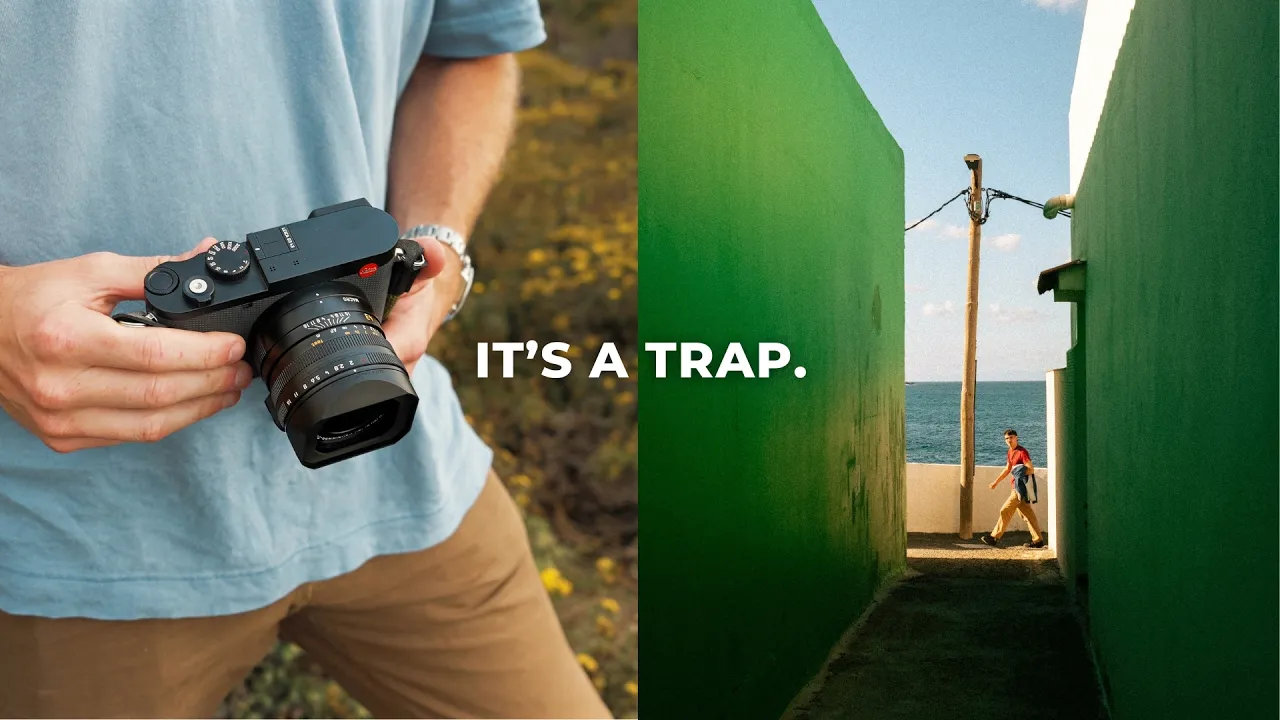
The Boring Middle of Photography (and How to Get Through It)
Photography Basics
Not a beginner anymore, but not advanced either? Here's how to get through the boring middle of photography, and how to thrive in it.
·
12 min read

When we first start out with photography, everything feels super exciting. You're improving ridiculously fast, day over day, and your photos start getting some love and attention. But very quickly you enter a new stage that I like to call the boring middle, and all of a sudden everything slows down.
At this stage, you're an intermediate photographer. You're not a beginner anymore, but you're not advanced either. You know how your camera works, and occasionally you go out and shoot an absolute banger. But you're not consistent. One day you shoot something epic, and the next day you feel like you're not making any progress at all, and you might even think your photos kind of suck.
This can be a really frustrating stage, and it's where a lot of photographers slow down or stop shooting altogether. I was in it for about four years before I progressed to the next level. So in this post, I'm talking about how to not only get through the boring middle, but how to thrive in it. Let's go!
READ OR WATCH: This blog post is also available in video form! If you'd rather watch me explain this content, simply watch the video below. Otherwise you can find the text guide below. Just keep scrolling!
In Intermediate Photographers, You Need to Hear This, I walk through every tip in this post.
What is the boring middle of photography?
The boring middle is the stage after the beginner phase, where your progress slows down and your results get inconsistent. You understand your camera and you can shoot a great photo now and then, but you can't do it reliably. It's a frustrating in-between stage, and it's where a lot of photographers lose motivation and stop shooting.

The good news is that it's a stage, not a dead end. Here's what helped me get through it.
1. Recognize that it's probably all in your head
First up, it's incredibly important to recognize that if you start thinking negatively about your photography (which typically starts to happen in the boring middle), it's likely all in your head.
According to the Dunning-Kruger effect, which I've talked about on the channel before, the better we get at a skill, the worse we think we are. That's why in the beginning we think we're absolute photography gods. But as we keep growing and getting better, we start comparing ourselves with other photographers and reflecting negatively on our work.

The only way through this is to recognize it, stay diligent, and keep shooting. I think one of the best things we can do is approach it with a constructive lens. If you start looking at your work and criticizing it, reframe that mindset by remembering the Dunning-Kruger effect exists, and tell yourself: "Hey, actually I think my work is pretty damn good. Look at how far I've come. I've progressed so much over the past few years. And even if my work isn't the best, I know there's still so much for me to learn, and I'm excited to learn it."

Try to get back to the learning and growth mindset you had when you started, and remember why you started photography in the first place. That's probably the most important thing you can do to escape the boring middle. Because if you start thinking negatively about your photography, you'll probably shoot a lot less, or stop altogether, and that's never a good thing.
2. Try new things creatively
When we first start out, we're so stoked to shoot literally anything: flowers, portraits of your friends, pictures of your cat, photos of the moon. It doesn't matter. You want to shoot everything because you're just so excited to be creative.
But as we grow, we start to pigeonhole ourselves into one specific style, whether that's landscape, street or portrait photography. That's totally fine. There's absolutely nothing wrong with pursuing a style you're drawn to. But there's something really exciting about branching out into a style you're not familiar with. It almost starts you over, because you have to rebuild those skills from the ground up.

Not only does that get your creative juices flowing again, it also greatly expands your knowledge of photography and can turn you into a multifaceted photographer who can effectively shoot across a much wider range of styles. (I wrote a whole post on this: why you should photograph everything.)
There have been so many times over the last 10 years where I just got bored shooting what I was focused on, so I pivoted and tried something new. Now I've cycled through so many styles that I've put together a body of work spanning street, landscape, portrait and still life photography. Whatever the style, I was probably obsessed with it for at least a few months at some point. And I still try new things to this day, because there's still so much for me to learn and it's really exciting. Be curious and be creative, because photography is a creative art form at the end of the day.

Don't run on empty. With that said, creativity can be a little tricky. One thing I've realized is that I can't be creative if I'm constantly running on empty. Creativity really has nothing to do with the gear or technique you use. It has everything to do with the energy you bring to your shoots, and for me, that starts with sleep.
3. Build a community of other photographers
One of the things that was incredibly helpful for getting through the boring middle, and is still incredibly helpful for me today, is community. Having a community of like-minded creative people or other photographers is one of the best things you can do to keep growing.
Not only is it way more fun to go out and shoot with people who want to see the world the way you do, it also gives you a rock-solid feedback loop you can rely on pretty much anytime. Every time I finish an editing session and have some photos I think are in a good spot, I almost always send them to a few friends to see what they think. Sometimes you just need another set of eyes on your work to feel more confident about it, and they can pick up on little things you missed.

For example, the other day I sent one of my photos to my friend Elliot. He took a look and said, "Hey, I think this is actually a little too green. Maybe add a little more magenta back in to balance it out." And he was absolutely right. When I went back to my computer, it definitely was a little too green.
That creative community has been so helpful throughout my entire photography journey. I think we should all make an effort to build a community of creative people to bounce ideas off of, especially people who are into the same style of photography as you.
4. Find your weak points and attack them
Your community can also help you pick up on weak points in your photography. By this point, you're probably pretty aware of yours, whether it's lighting, composition or editing (that's a big one for a lot of people at this stage, and I definitely struggled with it). Because you know what they are, you can focus on improving those specific skills through targeted activities.
Targeted activities add creative constraints to the photography process, so you can really focus in and improve one specific skill. Here are two I've used:
If you struggle with editing, edit the same photo in five different styles. Lightroom makes this super easy because you can save each edit as a different snapshot. Do this with multiple photos, then send all five versions to a friend and see what they think. It forces you to be more creative with your editing and look at your photos in a different way.

If you struggle with composition, capture 50 different photos of one single subject. The subject isn't moving at all, and your focal length is locked (50mm, 35mm, 85mm, whatever you're using). The only thing that can move is you. It really forces you to think outside the box and find 50 unique perspectives, and it breaks the compositional tunnel vision you've built up over the last few years.
The point of exercises like these isn't to walk away with a bunch of cool images. In fact, the end result doesn't matter at all. The purpose is to improve the one specific skill you struggle with, and adding constraints like this can be massively helpful for breaking through the weak points holding you back.
For me recently, that weak point has been color grading video. I've been doing it for years, but I always felt like there was a gap in my knowledge. So I've been spending 30 minutes a day learning DaVinci Resolve and how to color grade, and very quickly I've gotten so much better. I'm actually pretty confident in my color grading now.
5. Pick up a new toy (intentionally)
I didn't want to make this all about gear. But during the boring middle, when you're feeling a little less inspired, it can really help to pick up a new toy. Whenever I get a new piece of gear, I want to go out and use it, shoot, try something new and be creative.
There have been multiple cameras over the last few years that reignited my passion for photography. The Fuji X100V, and then the Fuji X100VI, made me fall in love with shooting again, specifically everyday photography, documenting my life and my travels. Another was the Konica Hexar RF, a 35mm film camera I still shoot with to this day, because every time I take it out it's just a fun experience.

And the most recent thing I picked up isn't a camera or a lens at all. It's a camera bag. I've used Shimoda bags for years, but I wanted something smaller and more compact, so I got the Urban Explorer 25, and I'm so excited to take it out shooting. Stuff like this just gets you inspired to go out and shoot again.
For you, this could look like a million different things, and it doesn't have to be expensive. Maybe you want to try a prime lens like a 24mm or an 85mm, or a versatile zoom so you can put one lens on your camera and shoot literally anything. It could even be something as simple as a diffusion filter that changes the look of your photos.
Most of us like to tell ourselves we're not gear people. But deep down, most of us really are, because it's fun playing with a new toy, and there's nothing wrong with that. You can go overboard very quickly, though, buying stuff because it makes you happy and then never using it. So my main tip here is to be intentional. If you want to buy a 35mm lens, buy it because you know how you're going to use it. Otherwise you'll end up with a bunch of gear you never use, too many choices, and gear paralysis every time you pack for a shoot.

As I've grown as a photographer, I've actually gotten rid of so much of the gear I bought over the years and consolidated my kit, because I know what works for my style. But that doesn't mean I don't enjoy new cameras, new bags or new accessories that get me outside and shooting more. So if you've been eyeing that new camera or lens for a while and you have an actual use case for it, just go for it.
6. Stop waiting for inspiration
I've talked about inspiration quite a bit in this post, but now I want to focus on how unreliable it actually is.
As you grow and develop a style, you confine yourself to shooting very specific things, and it gets much harder to feel inspired unless you find exactly what you're looking for. You're not always going to find it, so you feel less inspired, and because you're less inspired, you shoot a whole lot less.
That whole problem comes from starting with inspiration first and relying on it to trigger you to go out and create. But inspiration isn't reliable, and it's not going to be around all the time. So, especially in the boring middle where you're probably not feeling that inspired to begin with, just go out and shoot anyway.

When you start with action, it often triggers inspiration, which triggers more action, and it feeds into a positive cycle where you're shooting more, getting better and taking more photos. Relying on inspiration to get you out the door is one of the worst habits you can have at this stage. You never know what you'll find. You might stumble across something that absolutely blows your mind and gives you a ton of inspiration going forward.
The moment you rely 100% on inspiration is the moment your photography dies, because inspiration just isn't going to be around all the time. I learned this from a photography friend about five years ago, and it's actually what got me into street photography, which is now my favorite style.
7. Change your environment
If all you do is shoot in the same place day after day, it can get a little boring. Sometimes all you need to do is book a trip and go somewhere new. Even a town or city a couple of hours away is enough. Changing your environment is one of the best ways to reignite your passion for photography.
I've been living in Bali for six years now, which is crazy to think about. This island is absolutely stunning. You've got gorgeous jungle waterfalls, beautiful beaches, giant cliffs dropping into the ocean, rolling rice paddies, and a culture that's fascinating, beautiful and very welcoming to photograph.

But I've shot here so much that I just don't see it the way I used to, and I'm not always that interested in going out to shoot. I still do (like we talked about, you can't rely on inspiration). But sometimes a change of pace is really nice. For me, Bangkok is only four hours away. I can hop on a plane for about 150 bucks round trip and be in an amazing city that I feel inspired to shoot.

Every time I go to Bangkok, or somewhere else in Southeast Asia, I feel so stoked about photography again. I want to try new things, be creative and learn, and that's super helpful for breaking through creative blocks, especially in the boring middle.

Everyone deserves a little getaway. It doesn't have to be an extravagant trip to some far-off country. It can be really simple: go to a nearby city, stay the night, and just be somewhere new.
So, how do you get through the boring middle?
Ultimately, the most important thing you can do is just keep shooting. You'll notice pretty much every tip in this post is about getting you outside, shooting more and engaging creatively with photography, because that's the only way you're actually going to improve. The only way to take great photos is to be out there shooting in the first place.
One of the things I like to say on the channel is: the more you shoot, the luckier you get. So if you feel like you're not consistent, keep going outside and shooting, and I promise you'll capture some absolute bangers as time goes on.
I was in the boring middle for a solid four years, which is crazy to think about. But these tips really did help me break through it and get to where I am today, with a body of work I'm actually really proud of. If you want to keep going, check out my post on how to find your photography style.
Happy shooting!
Do you vibe with my style? Most of the photos in this post were edited with my Film Vibes Preset Pack, the same presets I use to edit pretty much all of my images. Check out the Film Vibes Preset Pack

Get the look in one click
Film Vibes Preset Pack
30 film-style presets that give your photos a timeless touch, inspired by famous film stocks.
$34
30 presets · For Lightroom
Sean Dalton
Made with ☕ and a camera.