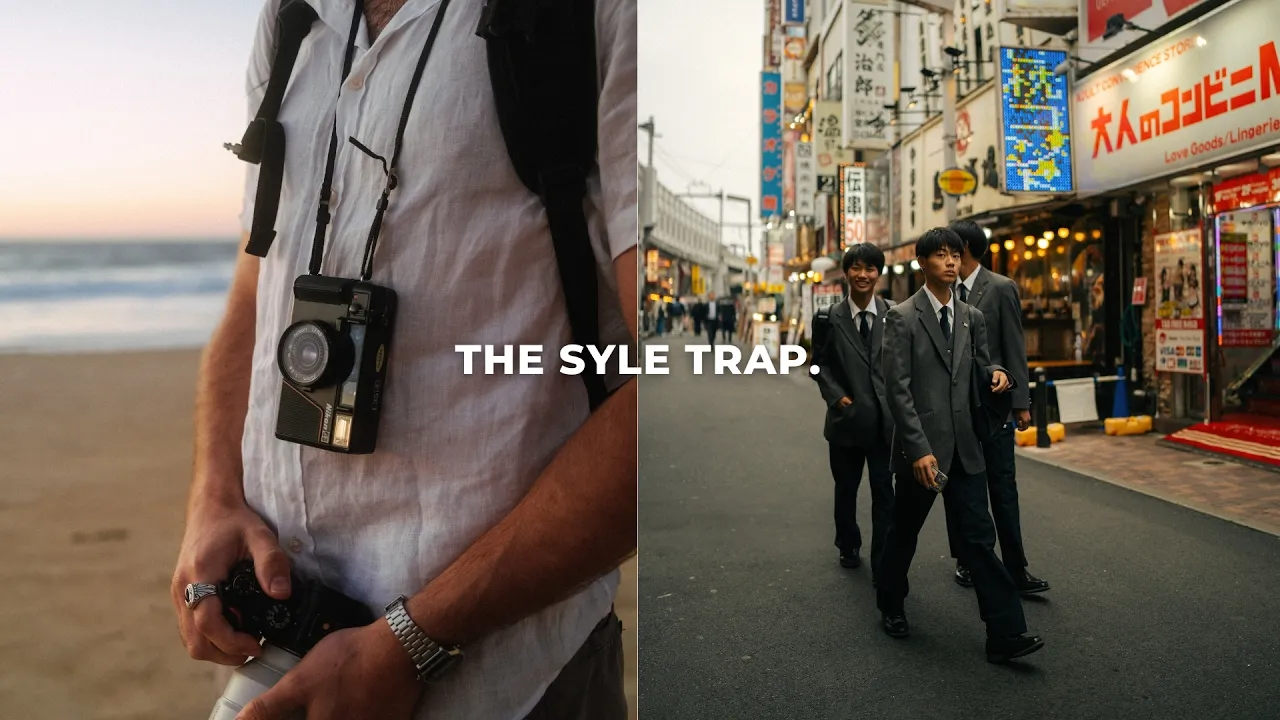
How to Find Your Photography Style
Travel
Photography Basics
Lightroom
Most photographers get style wrong. Here's the simple three-step process I use to find a photography style that's truly your own.
·
9 min read

One of the biggest turning points in your photography journey is when your photos stop feeling like a bunch of random, scattered one-off shots and start feeling like they fit into a larger body of work with a cohesive style.
But figuring out how to find your photography style isn't a straightforward path. And I think there's a LOT of confusion around how to actually do it.
Recently I spent some time looking back at the last 10 years of my photography: how my style has changed, what has stayed the same, and what became the foundation of my style today. That gave me a lot of clarity on how style actually works in photography, and how you can go about finding your own. So in this post, I'm sharing the three-step process I think you can follow to find your own unique photography style.
READ OR WATCH: This blog post is also available in video form! If you'd rather watch me explain this content, simply watch the video below. Otherwise you can find the text guide below. Just keep scrolling!
In Most Photographers Get Style Wrong, I break down what style actually is and walk through the same three steps.
What is a photography style?
A photography style is the consistent use of specific visual or thematic elements in your work. That can be your subject matter, the light you shoot in, how you compose, your colors and the story your photos tell. But style is never just one of these. It's the unique combination of all of them, used consistently over time.
Okay, before we jump into the nitty-gritty, let's break those elements down:
Subject matter: you're shooting the same type of subject across your work. Maybe that's cars, maybe it's portraits.
Light: you're consistently shooting in similar light. Maybe it's dramatic light at sunrise and sunset, or hard light where you really embrace that high contrast look.
Composition: a certain way you consistently compose your photos.
Color: a consistent color palette across your entire body of work.
Story: your images all tell a consistent story, or they all bring out a certain type of emotion.

For example, my style is defined by very bold colors. I'm not afraid to bring color into my scenes, and I like to lean into specific colors to really enhance the drama of a scene. But I also like a darker exposure. I like my images looking a little bit moody.
I also like to have one very clear subject set against an interesting background. It's not necessarily all about the subject, but rather how that subject exists in a cohesive setting and fits naturally into it.


Now look at Jack Harding, another photographer I've always really admired. He likes pretty high contrast scenes, but also very clean, dynamic compositions. He uses things like negative space, depth and diagonal lines to isolate his subject and guide your eye around the frame. And all of his images kind of tell the story of a dude driving around in a Porsche who likes nice things.
Or look at James Popsys. He typically leans toward brighter exposures and photographs very ordinary scenes, with lots of negative space and clean compositions shot at eye level. Nothing about his work is super crazy or dramatic. He's capturing an accurate depiction of real life, and he does it in a beautiful way.
Look closely at any photographer's style (mine, Jack's, James' or your own favorites) and you'll see it's made up of a unique combination of small creative choices. Put together, those choices create a visual signature that's unique to them.
That's what style is. And once you can break it down this way, it's a lot easier to find your own.
Step 1: Identify what you love in a photo
The first step is to identify your preferences. What do you like to see in an image? If you had a perfect photo, what would it look like?
This might sound simple, but it's incredibly important. If you don't know what you actually like to see in a photo, how are you supposed to know what direction to take your work?
The best way to figure out what you're drawn to is to create a mood board, or what I like to call a vision vault. If you don't have one yet, I cannot stress enough how important this is. It gives you a very clear direction for your work, and it helps you pinpoint the stylistic elements you like to see in a photograph.
My vision vault is just a bunch of images I found online that inspire me. I add and remove things often as my taste changes. I use Milanote to make mine (you can check out my vision vault here), but Pinterest works too, or you can even make one physically.

But just collecting inspiration isn't enough. You need to sit down, take a really close look at those images and identify specifically what you like about them.
I like to write a few notes directly on my mood board, but you can write them down anywhere or just think them through in your head. Either way, make sure you hit ALL of these:
Subject matter: Are there any common themes? Are all the photos of cars? Portraits? Still life?
Lighting: Is there a specific type of light you like? Really soft light, artificial light at night, or dramatic light at sunrise or sunset?
Composition: Are the compositions clean, with lots of negative space? Or are they busy, with a lot going on? Are they dynamic? Is there movement in the scene?
Color: Are there any dominating colors? Do they lean toward the warm side or the cool side?
Story: Is there a common story across all of these images? What emotions do you feel when you look at them as a whole?
There's no better way to figure out what you're truly drawn to than putting all your favorite images in one place and finding the themes across them. Those patterns give you an incredibly clear direction for your style.
Step 2: Process (bring those elements into your own work)
Step two is what I like to call process: taking the stylistic elements from your mood board and actually translating them into your own work.
And I think this is where a lot of photographers get stuck. It's easy to know what you like to see in a photo. It's hard to get those things into your own images.
A lot of photographers try to copy someone they admire one to one, doing everything all at once. Not only is that difficult (you're trying to account for all these different elements at the same time), but if you copy everything from another photographer, your style isn't going to be very unique, is it?
Instead, I think you should pull inspiration from lots of different photographers at once. Pick and choose the elements you like from each of them, then bring those elements into your own work one at a time.
For example, say you love how dynamic Jack's compositions are. But you also like James' focus on the ordinary, and how he captures everyday scenes in such a beautiful way. And maybe you also like the dramatic light I shoot in, or the bold colors I use. When you bring those individual elements together into one style, that's how you create something unique.
And don't try to work them all into your photos at once. The key is to hyperfocus on one or two at a time. That might mean shooting a specific type of subject matter for a day, shooting with a specific color palette in mind, or shooting in a very specific type of light.
When you really focus on one thing, you'll figure out how to capture that look a lot faster than if you try to do everything at once.


Step 3: Progression (let it become instinct)
The third step is, I think, the most important one. I call it progression.
Up until now, everything has been very intentional, right? Intentionally creating a mood board. Intentionally bringing the elements you like into your work. Progression is where your style becomes less intentional and more instinctive.
The more often you make certain creative decisions, like shooting in a certain type of light or composing your shots a certain way, the more naturally they start coming to you. And once you're naturally going after the things you love in a photograph, that's when your style emerges.
The key here really is time. This isn't going to happen overnight. You're not going to read this post and have your style tomorrow! It takes time to bring the things you love into your work in a natural way.
With my style, I don't think about what I'm photographing anymore. I see something I'm drawn to. I couldn't always tell you why, but I photograph it, and it just fits with everything else I shoot.
Ultimately, I think that's where everyone wants their style to be: natural, not forced. It can help to push it in the direction you want in the beginning. But over time it has to come naturally, and it will, as long as you keep making those small creative decisions every time you go out and shoot.
Now, there IS a way to speed this up: constantly reflect on your work and put it up against your mood board.
Every month or every few months, I take 20 of my favorite photos from that period and put them right into my mood board. Then I ask myself: do my images fit? Do they line up with the themes I identified when I first reflected on it?
If they do, you're making progress. If they don't, take a step back, reflect on those themes again, and go back to bringing them into your work one at a time. I also do this after every big shoot, asking myself whether the photos fit the direction I set out for myself.

It really all comes down to identifying what you like to see in an image, bringing some of those elements into your own work, slowly building them into your subconscious, and then letting that style evolve over time.
3 more tips for finding your photography style
Don't label yourself too early. Keep an open mind as your style develops, and don't latch onto one specific look or label too early. If you feel pulled in a direction that doesn't fit the one you laid out in your mood board, just go for it.
I also made a video about why you should photograph everything. The gist: every time you try a new style of photography, you pick up habits and preferences that carry over to everything else you shoot. As long as you're taking photos, it's all relevant.
So if you're intrigued by a style of photography that's not what you first pictured for yourself, I really urge you to go try it. It gives you more tools in your tool belt, and that's going to have a positive impact on your style.

Nail down your editing process. I say your editing process because everyone edits a little differently. The way I edit is probably a lot different from how another photographer edits, and that's fine. But you need to develop your own process, so that when you find an editing style you like, you actually have the ability to capture that look.
A huge part of this is becoming fluent with your editing software and knowing exactly which adjustments get you a certain look. There's a million different ways to get the same look in Lightroom, so find what works best for you.
Having my process nailed down gives me a ton of creative flexibility. If I like a certain look from another photographer, I have the process and the skills to bring it into my own edits. (If you want to learn mine, my Lightroom Masterclass has over five hours of super detailed editing lessons.)

Time is your friend. Your style is going to keep changing, and I think you should let it. Looking back at my images from the past 10 years, it's crazy to see where my photos were then compared to now: the similarities, but also the differences as my preferences changed.
So it's okay to go back into your mood board, get rid of images that don't fit your vibe anymore and add new ones in.


Ultimately, there's no finish line when it comes to finding your style. But as someone who has found mine, I can tell you the creative freedom it gives you is just immense. I can shoot pretty much anything I want without thinking, "Oh, is this going to match what I shoot?" because I naturally gravitate toward things that fit my larger body of work.
So, how do you find your photography style?
In short: figure out what you love in a photo, bring those elements into your work one or two at a time, and keep shooting until those choices become instinct.
If you're feeling a little lost right now, I hope this gives you some clarity and perspective on how to find your style. I promise, if you do the things we talked about here and give it a little bit of time, you WILL find your photography style.
I also have tutorials on a lot of the individual elements we talked about, like how to improve your composition, how to shoot in harsh midday light, how to get perfect color grades in Lightroom and my video on color theory.
Best of luck and happy shooting!
Do you vibe with my style? Most of the photos in this post were edited with my Film Vibes Preset Pack, the same presets I use to edit pretty much all of my images. Check out the Film Vibes Preset Pack

Get the look in one click
Film Vibes Preset Pack
30 film-style presets that give your photos a timeless touch, inspired by famous film stocks.
$34
30 presets · For Lightroom
Sean Dalton
Made with ☕ and a camera.