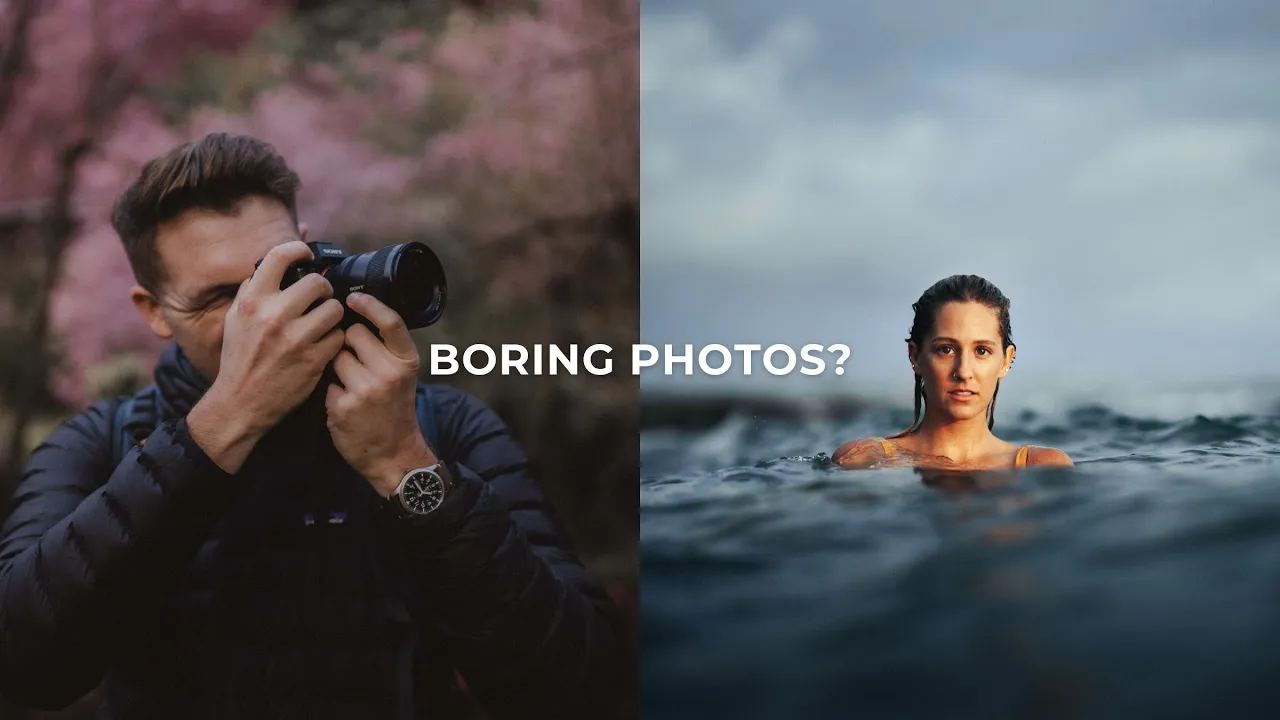
Why Your Photos Are Boring (6 Mistakes and How to Fix Them)
Photography Basics
If your photos don't stand out, or they look like everyone else's, one of these six common mistakes is probably holding them back. Here's how to fix each one.
·
8 min read

Maybe you feel like your photos just don't stand out, or they're not unique, or they look like everybody else's. I totally understand. When I was just starting out, I definitely felt like my photos weren't unique, and it took me quite a while to get to the point where they stood out and got a little more attention.
So in this post, I'm covering some of the common mistakes that keep photos looking boring, and how to overcome them so you can start capturing photos that stand out. Let's go!
READ OR WATCH: This blog post is also available in video form! If you'd rather watch me explain this content, simply watch the video below. Otherwise you can find the text guide below. Just keep scrolling!
In This is why your photos are boring, I break down each mistake with examples from my own work.
6 reasons your photos are boring
1. You're relying too much on the subject matter
One of the most common mistakes I see beginners make is relying too much on the subject matter. Don't get me wrong, subject matter is incredibly important. It has a massive impact on the story and the feeling of your image, which is ultimately the most important thing. But a beautiful location, a beautiful model or a beautiful subject doesn't automatically equal a beautiful photo.
When a lot of people first pick up a camera, they think, "I'll go to this beautiful location and capture cool photos because it's beautiful." But there's so much more that goes into a photograph: the stylistic elements (lighting, composition, color, detail) and the technical side (lens choice, your perspective relative to the subject). All of these come together to shape the outcome.
So next time you're shooting somewhere beautiful, don't be lazy and rely on the location. Look for interesting ways to photograph it. And on the flip side, just because you're somewhere ugly doesn't mean you can't capture a cool photo.

2. Your photo doesn't have a clear subject
Building off that, subject matter still matters a lot, and the second reason your photos might be boring is that there's no clear subject. A clear subject pulls the viewer into the image, anchors your composition and helps tell the story. If there are so many things happening that there's no anchor, the viewer's eyes hunt around the frame, get lost and fall off.
The best way to describe this is with an example. This is a photo I shot in Sumba, Indonesia. It's a gorgeous landscape, with a beautiful sunset and the valley off to the left. But there's no clear subject. Where is your eye supposed to look? Nothing anchors you into the composition.

What if I told you I photoshopped out a little town in the bottom right corner? Put it back in, and now there's an anchor point, which gives the photo so much more purpose and meaning.

I'm not saying every photo needs a clear subject. There are beautiful images without one. But generally, a clear main subject makes a photo easier to look at and gives it more purpose. Even in landscape photography, a subject can ground the composition: a boat, a little house in the corner, or a person, which I use often because you can position people where you want them. It doesn't have to be in the middle or on a third. It just needs to be very clear what you're photographing.
3. Your photos lack depth
Depth is everything in photography. It guides the viewer's eyes from the front of the frame to the back, gives context to the scene, and adds so much visual interest that it helps with storytelling and makes an image strikingly more beautiful than a flat one. Not every photo has to have depth, because photography is situational, but generally it adds a lot. Here are three ways to add it.
Use a foreground element. Step back and find something close to you to put in the foreground. It adds a ton of depth and can frame your subject too. If there's nothing around you, get low and use the ground itself. You don't need a foreground, midground and background in every image, but when you can get all three, your image gets much more interesting.

Look for leading lines. Leading lines guide the viewer's eyes from the front of the frame to the back. They add depth and highlight your main subject, because the eye just follows the line to it. Besides beautiful subjects and beautiful light, leading lines are what I'm almost always looking for when I'm out shooting.

Watch your aperture. Opening up to something like f/1.8 gives you a shallower depth of field and separates your subject from the background. But be careful. If the depth of field is too shallow, there's actually no depth at all, just your subject and an obliterated background. I used to do this all the time with my first prime lens. I shot everything at f/1.4 because it looked so cool. Instead, choose an aperture that shows your subject in their environment. That's much more interesting.
4. Your photos are too polished
This one is 100% subjective, but I've noticed that photos that are a little more raw, with imperfections, are standing out more now than photos that are perfectly sharp and rich in color.
As camera technology has gotten better, there's been a massive push toward realism: the sharpest photos possible, the richest colors possible, everything looking almost more real than real life. I think that's gotten stale. The photos standing out now embrace the imperfections of photography. That's why I think film photography is doing so well right now. It has grain, old lenses, lens flares, maybe an exposure that's a little off, and those imperfections help tell the story.
So don't be afraid to do something a little different with your edit. Add grain in Lightroom, underexpose your image if it helps the story, or do what I like to do and add dust and scratch overlays in Photoshop. You drag one in, adjust the opacity, and you have an image with a lot more character. (Here's exactly how I add a dust overlay to my edits.)

5. You're not planning your shoots
This depends a lot on your style. Street photography is mostly serendipitous, so there isn't much planning. But landscape photography is 90% being in the right place at the right time, so you need to plan your trips to get the best weather, conditions and light.
Where I notice this most is portrait photography. A lot of photographers think a beautiful model in a beautiful location is enough. But there's so much more to a portrait shoot: what the model is wearing, the time of day, whether the location will be busy at that time, whether the light will be nice. Make sure the outfit suits the location, and research some poses you can direct your model into. Even having an idea of the overall vibe puts you way ahead of most photographers. (Here's how I plan a shoot in 5 tips to capture more creative portraits.)

6. You go into a shoot with too much bias
I just said planning is super important, and it is. But if you plan too much and go in with all these ideas locked in your mind, it can actually hold you back creatively. You always have to be able to pivot on location when things don't go to plan, and if you only have very specific compositions in mind, you'll miss the different compositions that location has to offer.
With landscape photography, it's easy to find locations through other photos online. But get there and you'll realize everyone is shooting the exact same composition. So look at one of those photos, ignore the rest, and look for a different composition when you arrive.
Some of my favorite photos were captured in incredibly popular places, where I went in with a fresh mind looking for something different. In 2020, my friend Kelsey and I went to Nusa Lembongan, to a beautiful spot where the beach acts as a leading line up to Mount Agung on Bali, the island next door. Every image I'd seen was shot from up on the cliff, with that line leading into the volcano. I didn't want to shoot the same composition, so we went down into the water and explored, and I captured a photo that's completely different but still has the same feeling of that location: the beach leading up to the mountain.

So yes, look at other photos of a location while you plan. But trust your creativity and look for different things to shoot. I promise you'll find something nobody else has shot, and your photo will stand out so much more because of it.
So, how do you make your photos less boring?
Don't rely on the subject alone, give every photo a clear subject, build in depth, let a little imperfection in, plan your shoots, and leave room to pivot once you're there. Be aware of these mistakes when you're out shooting, but also know you're going to keep making mistakes, and that's part of the process. As long as you keep shooting, your photos will keep getting better, and I promise they'll get less boring as time goes on. For more like this, here's why most photos are forgettable.
Happy shooting!
Want the resources I use for every shoot? My free Travel Photographer's Toolkit has a ton of useful resources, the essential apps I use and a detailed gear list.


Sean Dalton
Made with ☕ and a camera.