11 Travel Photography Tips to Stop Shooting Like a Tourist
Travel
Almost 10 years of travel photography taught me a lot. Here are 11 tips to make your next trip less stressful and help you come home with much better photos.
·
12 min read

Travel is one of the key reasons so many of us get into photography in the first place. All the new sights, sounds and smells, and all the different foods we get to try, bring out a new level of creativity in us. And there's nothing more addicting than that feeling.
I've been traveling and taking photos for almost a decade now, which is absolutely insane. Early on, my photos were halfway decent, but I'd like to think they've gotten a lot better since then, and I've learned so much along the way. So in this post, I'm sharing the travel photography tips that will make your next trip, number one, less stressful, and number two, help you walk away with much better images. Let's go!
READ OR WATCH: This blog post is also available in video form! If you'd rather watch me explain this content, simply watch the video below. Otherwise you can find the text guide below. Just keep scrolling!
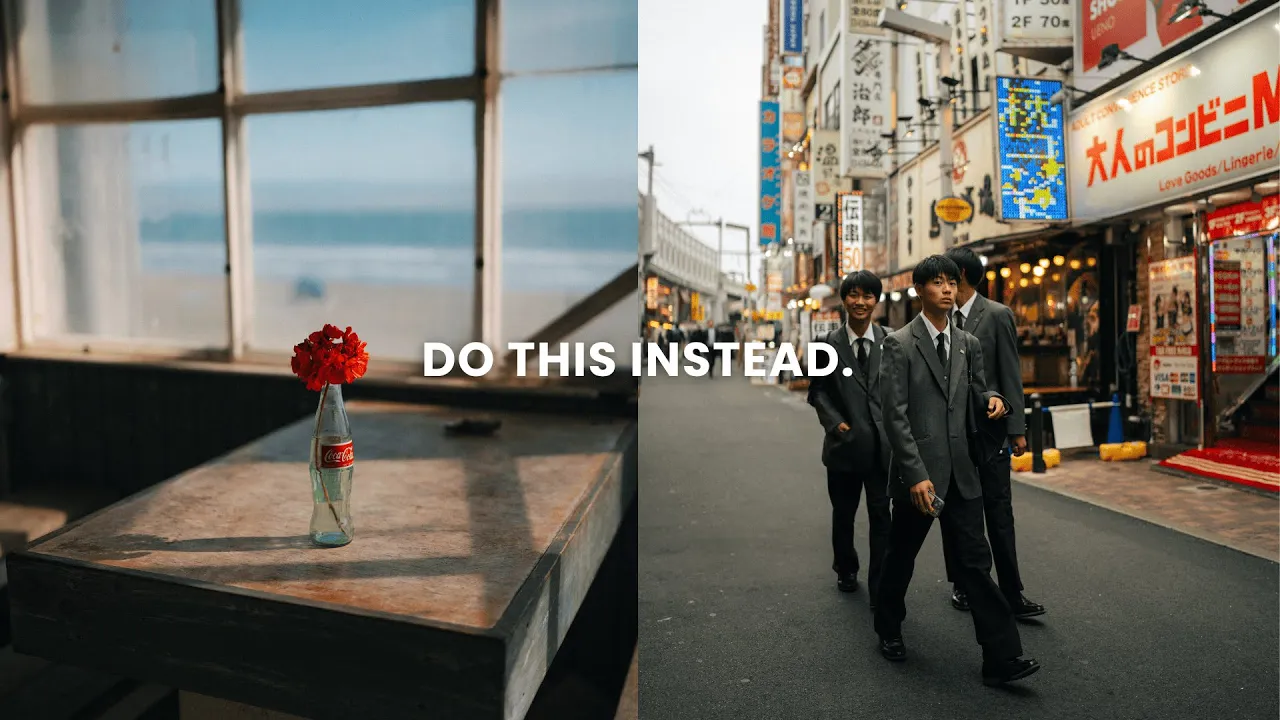
In Stop taking photos like a tourist., I walk through every one of these tips with photos from my travels.
1. Have a plan for flying with your camera gear
Everyone knows we should always carry on our photography gear. We never want our camera, lenses or batteries under the plane. They throw those bags around, and showing up at your destination with your gear wrecked into a million pieces is an absolute worst nightmare.

Some airlines are extremely strict about the weight or size of your carry-on, so you need a plan in case they ask you to check the bag with your gear in it. When you book your flight, if there's an option for a heavier or extra carry-on, just book it. Or book a higher class so you board first, which keeps your bag safe if the overhead bins fill up.
But what if you didn't do those things and they ask you to check your bag? I like to travel with a modular system: a backpack with a camera cube inside, plus a smaller shoulder bag that holds a bit of gear. If they ask me to check the backpack, I pull out the camera cube with all my gear in it, plus my little bag full of batteries, and carry those onto the plane instead. Being able to pull your camera cube out and carry it on is a massive hack.
2. Know what gear is best for each trip
Building off that, the best way to avoid the headache of traveling with a bunch of gear is to not bring too much in the first place. But instead of just calling this "bring less gear," I think a more productive way to look at it is: know what gear is best for each trip, and don't bring more than you need.

If I'm going on a dedicated photography trip to shoot landscapes and some crazy street photography, I bring all my serious gear: my Sony A1 II, maybe the 24-70mm, my 35mm prime and the 70-200mm. I'll probably bring my little Fuji too, for a night out or more casual days. But for other trips, I might only bring the Fuji or my film camera, because the trip isn't 100% focused on photography.
If you're just getting into photography and you're not sure what you'll need, a good rule of thumb is to bring one versatile zoom and one prime. For me, that's a 24-70mm f/2.8 and a 35mm f/1.4. Those two come with me pretty much everywhere, because I get the versatility of the zoom, plus the wide maximum aperture, beautiful image quality and simplicity of the 35mm prime. (If you haven't heard me rave about it yet, here's how to shoot with a 35mm lens.)
Before you travel, ask yourself: am I actually going to use this lens, or am I bringing it for one specific photo I might take? If you only have one image in mind for it, don't bring it. You'll save yourself so many headaches, both packing and walking through a giant airport with a heavy backpack. (Here's everything I packed for two months in Spain, in my travel photography gear.)
3. Build a mood board for your trip
A mood board is a collection of images that inspire the kind of photography you want to pursue on a trip. It gives you a ton of clarity on the direction and style you want to take your work, and it can also help you plan the trip and highlight specific locations you want to hit.
It can be as simple or as complex as you like. I keep mine simple: a group of images I look at as a whole. I'm not trying to recreate any single photo 100%. But when I look at all of them together, I can see the common themes I want to capture on that trip.

I make a mood board for every single trip. I had one for Japan last year, a collection of images that inspired the style I wanted to pursue there, and if you look at the photos I shot in Japan, I think they line up pretty well.

I use Milanote, because it works really well for me, but Pinterest, Notion, or whatever is easiest for you to access before and during your trip works too. You can find images pretty much anywhere: Instagram, Flickr, 500px, or even a simple Google search.
4. Follow the minimum five-minute rule
When we're traveling, we're feeling so creative and excited that all we want to do is run around and find cool stuff. I totally get that. But it's easy to move on from a scene that deserves more time. In a city, there are so many things fighting for your attention, and the worst thing you can do is move on from a great scene because something else grabs you or you think there's something better around the corner.

So when I find a scene like that, I stop and wait for at least five minutes to see if someone walks into the frame and creates the shot I've envisioned. So many legendary photographers have done this. Henri Cartier-Bresson called it the decisive moment: waiting for the perfect person to walk into the perfect part of the frame. And Fan Ho, one of my favorite photographers of all time, who photographed Hong Kong in the 50s and 60s, talked in interviews about how important patience was. He'd find a setting that looked great, but needed a subject to walk into it, and he'd wait 10, 20, 30 minutes, up to a few hours, to get that shot.
These examples are about street photography, but the lesson translates to any kind of photography. With landscapes, the light is constantly shifting, and 10 minutes can be the difference between an average photo and a great one. So if a scene tickles you a little, wait it out. Something cool might happen.

5. Don't overplan your trip
I know a lot of us don't have much time on these trips. Maybe you only have three days or a week, and there are so many places you want to hit. I totally get that, but it's a slippery slope. If you plan your trip down to the minute, you won't allow serendipity to set in, and you won't get truly immersed in the place.
Sometimes you need to put your phone in your pocket and just get lost. Walk in any direction that looks interesting for a few hours and pay attention to what you see. It's totally okay to have some specific photo locations saved, but give yourself time to explore too.

I promise you, no matter how much research you did, there's still so much in that place that hasn't been shot yet. Some of my favorite travel photos were shot in locations that weren't saved anywhere online, that no one knew about. I found them because I went out, got lost and discovered something new. And it's just so fun to get lost, because you're fully immersed in the place. There's no better feeling.

6. Try new things creatively
Your creative juices are absolutely pumping when you're traveling, which makes it the perfect time to try new things: turn your camera to the side, experiment with slow shutter speeds, and break the mold you've forced yourself into as a photographer.
Say you never really shoot at night at home because you're tired and there's nothing that interesting around. Travel is the perfect opportunity. You're still excited and buzzing from the day, and there's still so much to explore, so head out and try something different.

Keep your head on a swivel. It's also really important to expand your vision. Look up, look down, look to the side. There are so many things you probably don't notice because you've trained yourself to look for one very specific thing. I played American football in college as an offensive lineman (I used to be a massive person), and my coach always said, "Head on a swivel." You're constantly searching left, right, up and down. It's the same with photography.
This matters for storytelling too. Some places are defined by the smaller things you probably wouldn't notice, like the architecture or the trees in that specific city. Photographing those smaller details can help you tell a much more meaningful story about a place.
7. Shoot for diversity
Speaking of story, that's ultimately the most important thing in photography. That leads me to the next tip: shoot for diversity. Shoot a wide range of images that all work together to tell a more meaningful story about a destination: landscapes, portraits, still life, street photography, even macro and texture shots.

When you bring all of those images together, you tell a much deeper story about the place. So if you're a specialized photographer, maybe really dead set on landscapes, stretch yourself a little. As you move from one location to another, keep your camera out, notice things, and capture more diversity. (I wrote a whole post on this: why you should photograph everything.)

Plus, shooting a wide range of photos is way more fun, because it opens up everything you can shoot. I love going out in a new city or country and photographing anything and everything that looks interesting, because a diverse collection of images does a much better job of telling a place's story than one single banger.

8. Plan photo time when traveling with a partner
This tip is for those of you traveling with a companion who isn't really into photography, at least not to the level you are. Maybe it's your partner or your best friend. I've been in this situation myself. I've been with my girlfriend for two and a half years, and we love traveling together, but she's not a photographer, and she doesn't want to walk 30,000 steps searching for things to shoot. Meanwhile, all I want to do on these trips is eat and take photos.
The best advice I have is, first and foremost, communicate. Tell them, "Photography is a huge part of what I do and something I absolutely love, and I'm going to need some time on my own to take photos." Have this conversation before the trip, so they can plan things to do while you're out shooting.
Even then, it can be hard to carve out the time. So I make sure to shoot sunrise. Chances are whoever you're traveling with is still sleeping, and it's an amazing time to shoot. The light is nice and soft, and it's a fantastic time to watch a place wake up, with older locals out on their morning walks or whatever is going on there. You'll probably have a few hours to yourself every single morning.

9. Protect your gear from theft
After my first travel photography tips video, a lot of people asked how I keep my gear from getting stolen. This largely depends on where you're going. Some places are incredibly safe and it isn't something you need to worry about much. In others, you're rightfully concerned and should take some measures.
Keep your gear in front of you and your pockets empty. When I was in Barcelona a couple of years ago, a city known for pickpockets (especially in some neighborhoods down near the water), I always kept my gear in front of me with empty pockets. There was no way to steal my gear without actually robbing me, and since I'm quite a large human being, the chances of that are rare. In cities like Barcelona, Paris or London, make sure your gear is safe.

Never, ever leave your gear in a car. Even if it's locked, they can easily break the window and grab your stuff. This happens so much near the Golden Gate Bridge in California: tourists leave their gear in the car, and it's a smash and grab. They're gone in 20 seconds. It happened when I was in Portugal, too. Luckily, I had my gear with me, but my friend's partner left an expensive purse in the car. We were gone for 15 minutes, they broke the window, and it was gone.

Carry AirTags. I put one in all my camera bags and my checked luggage. It's great for tracking your stuff while you travel, and if something does get stolen, at least you have some recourse to get it back.
10. Learn a few key phrases
You're not expected to learn a whole new language for a weeklong trip. But learning a few key phrases helps you connect with locals on a deeper level and makes them feel more comfortable around you. People love it when you try to speak their language and make mistakes. That goes for any country on the planet. It can also give you more access as a photographer, because that person now feels comfortable around you.

Here's what I learn before every trip:
Hello, good morning, good afternoon and good evening
Thank you very much. Not just "thank you," but the most polite form you can find. It can really open doors.
Excuse me, or I'm sorry
Is it okay if I take a photo (of you)? This one is really important. You can ask people on the street, or ask whether you're allowed to take photos somewhere.
The best way to learn these is YouTube. There are free tutorials for pretty much any language you can think of.
11. Be respectful
My last tip is simple: be respectful. When you're traveling, the customs, norms and ways people live their lives are probably very different from where you grew up, and it's important to always be aware of that. Respect goes a very long way anywhere in the world.
Remember that you're an ambassador of your country when you travel. Treat people kindly, say please and thank you, and respect local customs. Know when you should and shouldn't take photos, and do a little research about the customs of the place you're visiting. I hate that I have to say this, but a lot of tourists treat a foreign country like they're at home. You're not. You're a visitor, so treat the country and its people with respect.

So, how do you stop taking photos like a tourist?
These are some of the things I've learned over the last 10 years as a travel photographer. Plan for your gear, pack only what you'll use, build a mood board, slow down, get lost, try new things, shoot for diversity, protect your gear, and treat every place with respect.
And if you have a trip coming up, the only other thing I want to say is: go have fun. There's nothing better than going to a new country with your camera, eating the food, taking photos and immersing yourself in the place. It's the thing I love doing most on this planet. If I had a billion dollars today, I'd be doing exactly what I'm doing now. If you want more, check out why your travel photos are disappointing.
Happy shooting!


Sean Dalton
Made with ☕ and a camera.