The Best Lens for Literally Everything (Why I Love the 35mm Focal Length)
Gear
I've loved a lot of lenses over the years, but one focal length has stuck with me through my whole career. Here's why I think 35mm is the best lens for literally everything.
·
8 min read

Throughout my career, there have been several lenses I've really loved. It was 50mm for a while. It was 85mm for a while, when I was shooting all these really cool photos of coffee. And there were a few periods where I shot almost exclusively with zooms, because of their versatility.
But there's one focal length I've used extensively throughout my entire career, and that's the 35mm. I can shoot absolutely anything with it: landscapes, portraits, automotive, interiors, architecture, street photography, travel photography. I think the 35mm focal length can do it all better than any other lens. So in this post, I want to talk about why I think it's so special, and how I've been using it in my work over the past five or six years.
READ OR WATCH: This blog post is also available in video form! If you'd rather watch me explain this content, simply watch the video below. Otherwise you can find the text guide below. Just keep scrolling!
In The Best Lens for Literally Everything, I share a ton of the photos I've shot at 35mm.
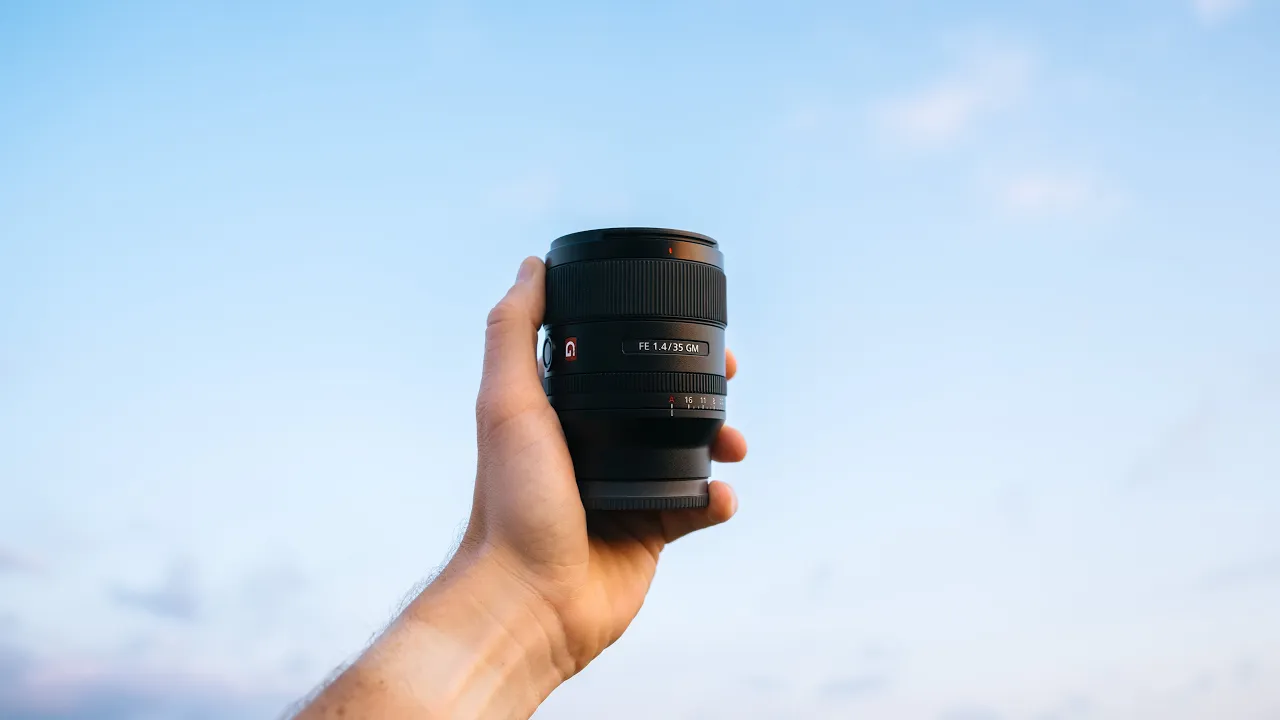
Quick note: I'm not talking about a specific lens here. I shoot with the Sony 35mm f/1.4 G Master, which I think is one of the best lenses ever made, but this post is about the 35mm focal length and its angle of view. (If you want practical tips for shooting with one, here's how to shoot with a 35mm lens.)
Why 35mm is the sweet spot for photography
I talk about 35mm all the time, and I use it more than any other lens, for one simple reason: I think it's the sweet spot for photography.
35mm sits right on the cusp of being a wide-angle lens, like 28mm or 24mm, and right on the cusp of being a more zoomed-in lens, like 50mm. That means it's wide enough to show the scene around your subject and give them context, but not so wide that it distorts your image and makes it hard to keep your composition clean.
I'm really drawn to clean, organized compositions, and when I shoot wider than 35mm, I find it really hard to get them. At the same time, I do want to show a lot of the scene around my subject, because it helps tell a much more meaningful story about the person, place or thing I'm photographing. That's really hard with a 50mm or 85mm.
So 35mm is right in the sweet spot. It's wide enough to show the scene and tell a more meaningful story, but not so wide that your composition gets overly busy, or that it's hard to keep distracting things out of the frame. I think that's why it's the sweet spot for storytelling in photography. (Here's more on storytelling in photography.)

A focal length for everything
Because 35mm is so balanced, it's incredibly versatile. I've shot some of my favorite landscape photos of all time at 35mm, plus contextual portraits that show the scene. I think it's the best focal length for street photography, and for documenting moments in everyday life, at home, at a friend's house, or on your travels.

The 35mm focal length is actually one of the main reasons I picked up the Fuji X100V, and now the X100VI. They have a 23mm f/2 lens, which is a 35mm equivalent on full frame. Ever since I got one, I've been shooting even more at 35mm, and I've captured some really amazing photos with that little camera. I attribute a big part of that to its 35mm lens. (Here's my take on the Fuji X100VI as a travel camera.)

It looks like real life
The versatility argument for 35mm is pretty common, so here's another reason I love it: it's incredibly easy to understand, both for you as the photographer and for the people looking at your photos.
35mm looks incredibly close to how we see the world with our own eyes. That makes it much easier to start seeing the world through a 35mm lens. At this point in my career, I pretty much do. When I'm walking around and want to shoot something, I already have a good idea of how it'll look at 35mm, because that's the focal length I default to. Developing that relationship with a focal length makes it so much easier to envision your shots before you take them, and that's a lot harder with a much wider or much tighter lens, because they look nothing like how we actually see.
Photos shot at 35mm also make more sense to the viewer, because they look more like real life. A 35mm photo doesn't scream, "Hey, look, I'm a photo," the way a 16mm or 200mm photo does. These days, I think people are much more drawn to authentic, real-looking photos, things that could actually happen and look real to the human eye. Yes, that means you might not get as much wow factor as an ultra-wide or ultra-zoomed shot. But there's a lot of beauty in keeping things realistic, and it's an interesting challenge too.

35mm is great for video too
For all the same reasons, I think 35mm is fantastic for video. As a YouTuber and photographer, I shoot just as much video as photos, and I use this focal length constantly, both for studio filming and for vlogs and cinematic shots when I'm out and about.

Why 35mm is great for portraits
A lot of us read early on that the best focal length for portraits is around 85mm, because there's no distortion and it's the most flattering. For headshots, I think that's absolutely true. An 85mm is fantastic for headshots.
But for everyday portraits, where you're trying to say something about the person or tell a deeper story, nothing beats 35mm, because it lets you show the scene around them. With an 85mm, you're limiting your field of view to just the person, and not much of what's happening around them.
Including the scene around your subject might make it a harder portrait to capture, because you have a lot more compositional elements to manage. But the impact on the story is massive, because you can use the environment to say so much more about the person. Even when I shoot with an 85mm, I find myself backing up really far so I can still include things around my subject.
So if you're just starting out and you've read that the best focal length for portraits is 85mm or longer, I'd really encourage you to try something wider, like 35mm, and challenge yourself to use the scene around your subject. When my roommate Kelsey and I went out to an epic location in Bali to shoot through sunset, I brought my 50mm and 85mm too, but the photos from the 35 were the most pleasing, the most engaging, and told the most story.

The classic street photography focal length
The last thing I want to mention is the history behind 35mm. So many amazing photographers throughout the ages have shot primarily at 35mm, and I think a lot of us now see it as a very classic, traditional focal length. Some of the most famous street and documentary photographers of all time used it to great effect.
Street photography is something I'm doing more and more as I grow as a photographer, because I just love going out in a city and finding beautiful things. And 35mm is perfect for it, because it's so versatile in a city, no matter your style. If you want to focus on people and document scenes realistically, 35mm is great. If you're more of an environmental street photographer like me, looking for light, shapes, color and things that are just beautiful, 35mm lets you do that too.
When I'm shooting street, 35mm isn't even an argument for me. I put it on my camera, go outside, and almost always walk away with photos I'm proud of. (I once spent a whole weekend in Bangkok shooting almost exclusively at 35mm.)

So, is 35mm really the best focal length?
For me, yes. It's the sweet spot between wide and tight, it's versatile enough for almost anything, it looks like real life, and it tells better stories, especially for portraits and street photography.
I hope this encourages you to give it a shot. If you have a zoom lens, lock it at 35mm and go out and shoot for a week. You'll get the same effect as shooting with a prime. Or if you're in the market for a new prime, try a 35. It's really changed my work in a positive way. I used to shoot so zoomed in, but once I got comfortable with 35mm, it challenged me, and I've captured some of my favorite images of all time with it.
What's your favorite focal length? 28mm, 40mm, 50mm? I've been hearing a lot about 28mm and 40mm, and I really want to try them more. (Since then, I've shot with the Leica Q3 43, and 43mm won me over in a big way.) Let me know in the comments on the video.
Happy shooting!
Just getting into photography? If you're still nailing down the basics, my Photography Essentials course is a crash course in everything you need to know.


Sean Dalton
Made with ☕ and a camera.