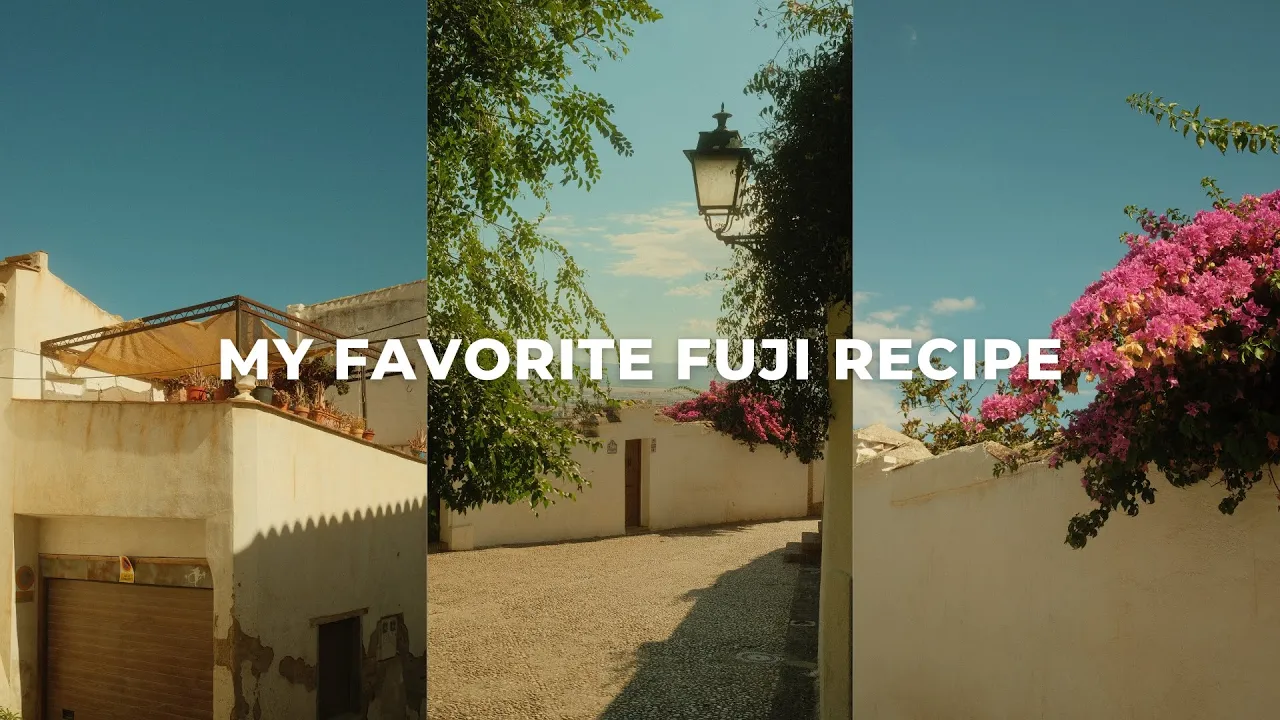
Street Photography in Granada, Spain With the Fuji X100V
Travel
Granada has one of the most intact medieval neighborhoods in the world, and I spent a day getting lost in it with my Fuji X100V. Here are the photos, and how I shot them in hard summer light.
·
7 min read

I'd wanted to visit Granada, Spain for so long. It's packed with history, and it has one of the most intact medieval neighborhoods in the world. I got there the day before, walked around and explored a little, and there were so many compositions to be had that I couldn't wait to photograph it.
I shot mostly on my tried-and-tested workhorse, the Fuji X100V, plus my Sony A7 IV from time to time. In this post, I'm sharing a day of street photography in Spain, the photos from Granada, and exactly how I shot them.
READ OR WATCH: This blog post is also available in video form! If you'd rather watch me explain this content, simply watch the video below. Otherwise you can find the text guide below. Just keep scrolling!
In Street Photography in Spain with the Fuji X100v, I share more than 60 of the photos I shot in Granada.
Getting lost in the Albaicín
I spent the day shooting the Albaicín district of Granada, and it's so freaking cool. It's a proper medieval town, built between the 13th and 15th centuries, which means there was very little city planning. The streets wander and weave everywhere, and you can get lost in the labyrinth, which is exactly what I did. You turn a corner and suddenly you're in a beautiful plaza.
One of the things I love about old medieval towns without a structured grid is all the interesting shapes and lines, which make for such interesting compositions. I'd been shooting in Barcelona the week before, and it's a beautiful city I absolutely loved, but it just doesn't have the same energy as a proper medieval town.

Learn the history of where you shoot. When I travel, I love learning about the history and culture of the region I'm photographing. It makes it so much more real, and I feel a much deeper connection to my photographs. The Albaicín was originally Moorish, a Muslim area, until the Christians took it back over in the late 1400s. You can still see a lot of that old Islamic culture mixed with the Christian culture today: you turn a corner and there's a beautiful church, and a mosque on the other side.
One of the biggest sites in Granada is the Alhambra, an amazing palace and fortress complex. When the Christians took it over in the 1400s, that's where Christopher Columbus got his royal grant to go explore the world, which is fascinating from a historical perspective. Remembering the history of a place while I wander through it makes shooting so much more enjoyable.
Shooting in hard summer light with the X100V
As you can probably tell from the photos, the light was quite harsh. It was a beautiful sunny day, and who doesn't want that when they're traveling in Europe? But in hard light like that, I don't enjoy shooting with my Sony much. I don't like crushing the highlights or working with really hard light in scenes like these. (In a commercial setting, sure.) I prefer soft light.
But I really enjoy shooting the Fuji in hard light, because of a recipe I love called Summer. It absolutely crushes the highlights and adds a beautiful warmth to them, and it just looks so good. I used the Fuji more than the Sony on this trip because of all those sunny days and hard light. If you're coming to Europe in the summertime, I think it's the best recipe you can use. (Here's more on how to shoot in harsh midday light.)

My Fuji X100V settings for street photography
The last time I made a video about the X100V, I got a lot of questions about how I shoot with it, so here's my setup:
Aperture priority, always. I set shutter speed and ISO to auto and choose my aperture for the depth of field I want, keeping the light in mind. In low light, I'm typically at f/2 or f/2.8. On sunny days like this, I'm anywhere between f/4 and f/8, with f/5.6 being the sweet spot: great depth of field, the lens performs really well, and it lets in a good amount of light.
Exposure compensation, like crazy. Because I'm in aperture priority, I don't have a lot of direct control over exposure, so I use the exposure compensation dial constantly. If I want the highlights a little darker, I go down half a stop, a full stop, sometimes a stop and a half. And I think the Summer recipe looks really good overexposed a little in nice, even light, so sometimes I go up half a stop or a full stop.
Back button autofocus. I do this on all my cameras. I turn off focus on the shutter button and use a separate button for focus, so I can set focus once and shoot a scene multiple times. If the depth of field changes or I move closer or further away, I refocus.
The X100V feels like a third arm to me. I can take it everywhere, and it captures beautiful photos.

Learn to love the siesta
I definitely understand the significance of the Spanish siesta now. In summer, the days are so long and it gets so hot in the middle of the day that everything closes and everyone goes home to relax. My first few days in Barcelona, I tried to tough it out and shoot all day, and by 2 or 3pm I was a mess and had to go home.
So I learned my lesson: shoot in the morning, go home, take a nap, then go back out for sunset, then dinner, which is anywhere between 9pm and 11pm because the sun sets so late. I love that about Spain. There's so much happening in the evenings, everyone's out, and the energy is so good. People seem very happy and outgoing, and the quality of life seems really high.

Sunset over Granada
I somehow made it up to the top of the village, where I could see pretty much all of Granada, including the Sierra Nevada mountains. Such a gorgeous view, with perfect light. I tried shooting with my 70-200 a little to zone in on the city, but I think it was a bit too late and the light wasn't there. Still, it was so beautiful up there, watching people go about their lives while I kept shooting with the Fuji.

Putting the camera (for video) away
At a certain point on the trip, I just didn't feel like filming anymore. I love making videos and talking to the camera, but I also love the purity of walking around a city with one camera, just shooting photos, and the presence that gives me. So for the rest of the trip, that's what I did: I walked around and shot with the Fuji. There's something about it that makes me really engage with the process of street photography.

The next day, I woke up early and went to the Alhambra. It was absolutely stunning, one of the most beautiful things I've ever seen, but it was crawling with people, and I didn't feel like I captured many compelling photos there. I still recommend checking it out.
So, is Granada worth it for street photography?
Absolutely. Granada was my favorite part of Spain. I liked it more than Barcelona, and from a photography standpoint, more than Sevilla too. I felt so present shooting there. If you're heading to Spain, go to Granada, get lost in the Albaicín, take the siesta seriously, and bring a camera that makes you want to wander. (I've since upgraded to the X100VI. Here's a week of street photography with the X100VI, plus my travel photography tips.)
Which photo was your favorite? Let me know in the comments on the video.
Happy shooting!
Want to get more out of every trip? My Photography Essentials course gives you a super solid foundation, so your camera stops getting in the way and you can focus on the places in front of you.


Sean Dalton
Made with ☕ and a camera.