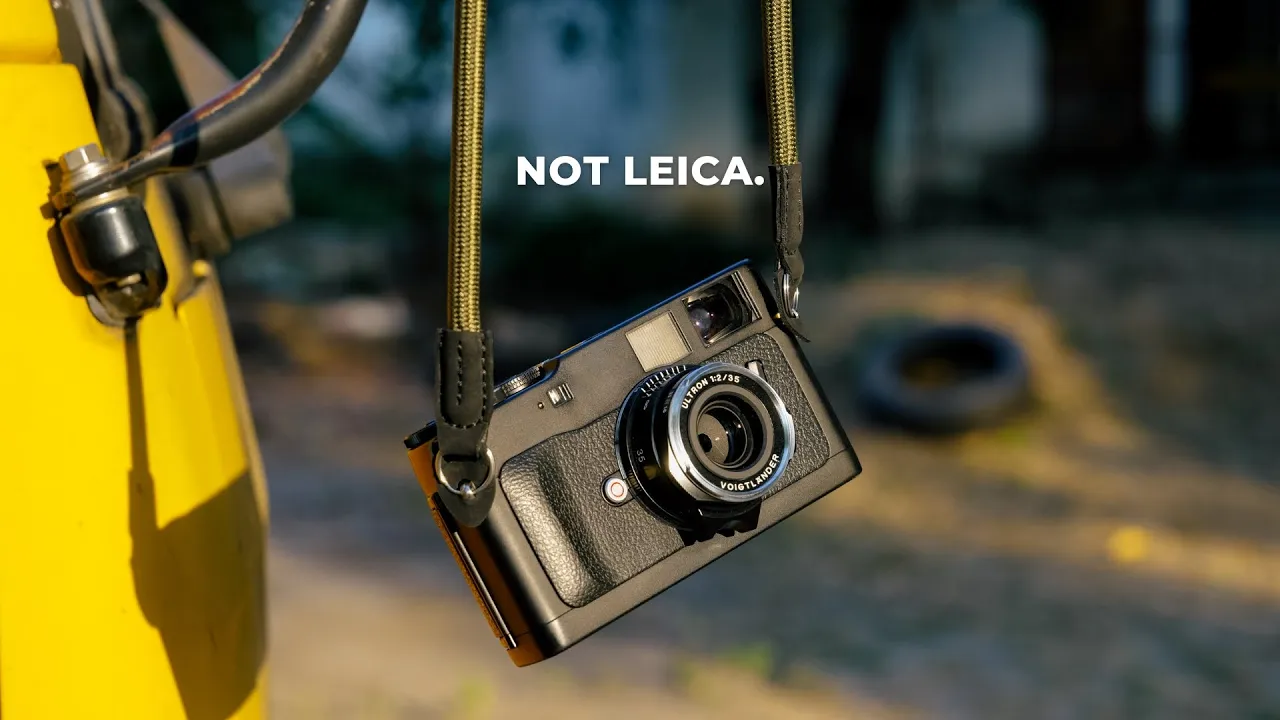
Konica Hexar RF Review: My Favorite 35mm Film Camera of All Time
Gear
I was about to buy a Leica M6 when a friend told me about the Konica Hexar RF. Here's why this fully electronic rangefinder became my favorite 35mm film camera of all time.
·
8 min read

I've been shooting film on and off for quite a few years, but toward the end of last year I wanted to treat myself to a more premium 35mm film camera: something I could carry every day, document my life with, and most importantly, just have fun with.
My only requirement was that it had to be a rangefinder. I wanted the big, bright viewfinder, the quiet shutter, the beautiful body and the small, compact form factor. The usual suspects came to mind first: the Leica M6, the Contax G2 and the Zeiss Ikon ZM. All amazing, capable rangefinders. Expensive, yes, but very good.
Just as I was about to pull the trigger on the Leica M6, a friend recommended a camera I'd never heard of: the Konica Hexar RF, a fully electronic rangefinder released by Konica in 1999. I did some digging, and despite some mixed reviews, I took the plunge and found one on eBay from Japan for about $1,200. Since then, I've shot a ton of film with it between California, Thailand and New York City. In this Konica Hexar RF review, I want to show you some of those photos and tell you why I think it's truly the best 35mm rangefinder ever made.
READ OR WATCH: This blog post is also available in video form! If you'd rather watch me explain this content, simply watch the video below. Otherwise you can find the text guide below. Just keep scrolling!
In My Favorite 35mm Film Camera of All Time, I share a ton of the film photos I've shot on it.
Build quality: not the plastic camera you've read about
When I got this camera, I was home visiting my family in California, which I very rarely do since I live in Asia full-time. So I was really excited to shoot some California vibes on film.

The first time I took it out of the box, I was super impressed with how it felt and looked. It has a really good weight to it. The Ken Rockwell review says it's cheap and made of plastic, and that's not true at all. It's beautifully built, and the top and bottom plates are titanium, a really beautiful, smooth titanium. It's not too big, it's a good balanced size, and the dials are easy to access.

It's fully electronic (and that's why I love it)
The most distinctive feature of the Hexar RF is that it's fully electronic. The shutter, film advance, film rewind and meter are all electronic. The only mechanical part is focus, because it takes manual focus Leica M-mount lenses.
That's one of the main reasons a lot of people are turned off by this camera. They want a fully mechanical experience, where even if the light meter breaks, you can still use it or get it repaired. With the Hexar RF, if the internals or the meter go, it's essentially a brick, a decoration for your desk at work. I was pretty concerned about that when I bought it.
But over the years, I've realized I really enjoy shooting film on a more electronic camera. I like the mechanical side, but I also like shooting with ease, using auto modes and keeping the experience simple.
AE-L mode. The mode that made me fall in love with this camera from the get-go is AE-L, aperture priority with exposure lock. I shoot in it 99% of the time. I think I've shot full manual once or twice, because I don't see the point. I point the camera at the midtones or shadows I want to expose for, half-press the shutter to lock it, recompose and take the shot. As long as I'm watching my shutter speed, it's essentially the same as shooting manual, because I'm reading the same meter. It's just easier and more efficient.
A big, bright viewfinder. The viewfinder is your connection from the camera to the outside world, so it's one of the most important things on a rangefinder. I wasn't sure about it, because some people say it's not nearly as good as the Zeiss Ikon ZM or the Leica M6. I found it really nice: big, bright, with a sharp rangefinder patch that's easy to use. The only issue is that your eye has to be quite centered. If it's off center, you might not see the meter, and the rangefinder patch can look out of alignment. I got used to that pretty quickly.
Exposure compensation dial. There's an exposure compensation dial on top, and I use it all the time. It makes it really easy to over or underexpose your film without calculating stops or changing the ISO dial.
1/4000 max shutter speed. This feature is really overlooked. A maximum shutter speed of 1/4000 makes it so easy to shoot wide apertures in bright sunlight. If you're shooting a portrait during the day and want a shallow depth of field without an ND filter, you can. The Leica M6 maxes out at 1/1000, and I believe the Hexar RF is a stop faster than the Zeiss Ikon ZM too. I usually stop down to f/5.6, f/8 or f/11 on film, but I love that I can shoot wide open on a sunny day.
All of that makes it one of the easiest cameras to shoot film on, even if you're a complete beginner. And not all film cameras are easy. When I started shooting film, I had no idea what I was doing and kept underexposing everything, like a lot of beginners do.

Lenses: Leica M-mount
Because it's a Leica M-mount body, you can use any M-mount lens on it. This was my first M-mount camera, so I didn't own any M-mount lenses. After a ton of research, I settled on the Voigtländer 35mm f/2 Ultron.
I knew I wanted 35mm, because it's my preferred focal length. It's why I love the Fuji X100V and X100VI so much: it's wide but not too wide, very cinematic, and just looks really good. (Here's why I love the 35mm focal length.) I think the Ultron is one of the best lenses you can get for the price, and it rivals Leica glass. It's sharp, has a ton of character, it's tiny and matches the body perfectly, and the focusing feels so smooth.
Honestly, manual focus is one of the main reasons I love shooting this camera so much. It's just fun. I'm always shooting autofocus on digital, so this makes me feel a much closer connection to the camera.

When Konica released the camera in 1999, they also released a series of Hexanon M-mount lenses: a 28mm, 35mm, 50mm and 90mm. They're highly reviewed, super sharp and look like epic little lenses. I'd love the 28 or the 50, but they were a bit expensive when I was shopping around. If you can find one with the body as a full set, that's the way to go. But I'm still very happy with the Voigtländer.

The drawbacks of the Konica Hexar RF
If it breaks, it's a brick. Like I said at the start, it's fully electronic, so if it breaks, it's very hard to fix. I went into the depths of the analog photography subreddits and found a few threads where people had gotten them repaired, but it won't be easy. I'd have to ship it somewhere, and it would probably cost more than it's worth.
On the flip side, one reason I wanted the M6 was that it's fully mechanical and easy to repair. But once I read about the repair process, it didn't sound that easy either. I'd have to ship it somewhere, people weren't sure if Leica still repaired the classic M6, and the wait times were six months to a year. So for me it just wasn't worth it. I want a film camera with me all the time. If it breaks, it breaks, and I'll buy something else. I want to enjoy this camera while I have it.
The viewfinder needs a centered eye. You do have to keep your eye quite centered to see the focus patch and meter accurately. I noticed it at first, probably because I'd read all the reviews. But once you start shooting, you completely forget about it. If you'd never heard about this, you probably wouldn't even notice.

The price. I paid about $1,200 for a mint-condition body from a very good seller in Japan, and I think it was worth every penny. It's a camera I'm proud to have and want to take care of. If you're buying one, I'd recommend spending a little more for a nicer copy, because if a camera like this has been dropped, you don't know what the electronics are like inside. So far I've had no issues, and I'm hoping it stands the test of time.
So, is the Konica Hexar RF the best 35mm rangefinder?
For me, yes. Even at $1,200, it was still half the price of a Leica M6, and it has way more features. I've captured some of my favorite film photos ever on it. It's a nice, fun, non-obtrusive shooting experience, which is exactly what I want when I'm shooting film. These days it lives in my everyday carry, and if you're curious how film compares to digital, here's whether a digital photo can actually look like film.
Let me know in the comments on the video if you want to see more film photography content.
Happy shooting!
Want my full film kit? My free Travel Photographer's Toolkit includes all the gear and accessories I use for film photography, plus essential resources and tools for photographers.


Sean Dalton
Made with ☕ and a camera.