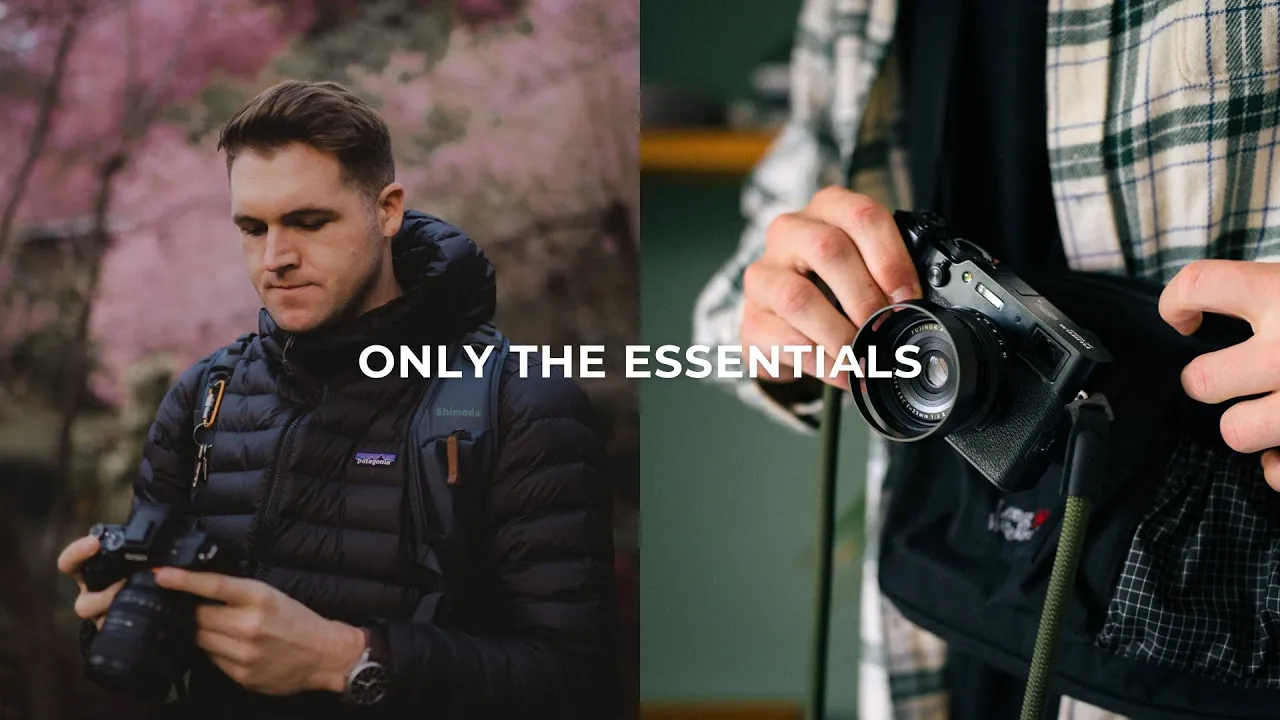
The Photography Gear Beginners Actually Need (and What You Don't)
Gear
When I started out, I thought I needed so much gear to take great photos. In reality, there are only a few things you actually need, and you'll keep them from day one all the way to going pro.
·
10 min read

When I first started out with photography all those years ago, I remember thinking there was so much gear I needed to capture great photos. I felt like I needed all these different things to get the photos I wanted.
In reality, there are only a few things you actually need when you're starting out, and they're things you'll keep with you from day one of your photography journey all the way until you're advanced or a pro. So in this post, I'm breaking down the beginner photography gear you actually need, and some of the things you don't.
READ OR WATCH: This blog post is also available in video form! If you'd rather watch me explain this content, simply watch the video below. Otherwise you can find the text guide below. Just keep scrolling!
In Stuff Beginner Photographers ACTUALLY Need, I pull every one of these out of my own bag.
1. A camera with interchangeable lenses
This post isn't specifically about cameras and lenses, so I'll keep this short, but I do think there are a few simple guidelines for your very first camera. The most important one: pick up a camera with interchangeable lenses.
My Fuji X100VI is an incredible little camera, and I love it for my personal life, but it doesn't have interchangeable lenses. When you're just starting out, being able to change your lens and get different looks in your images is super important. It teaches you how focal length affects your photo, it gives you a lot more options for upgrading later on, and in my opinion, those cameras are just better to learn on.
So I'd highly recommend picking up any cheap DSLR or mirrorless camera. APS-C (crop sensor) cameras are perfectly fine. Most of us started on a smaller sensor, so you don't need to spend a bunch of money on a full-frame camera right away.

2. Two lenses: a zoom and a 50mm f/1.8
I think it's really important to have two lenses when you're starting out:
A zoom lens. Your first camera will probably come with a kit lens, and that's okay if you can't upgrade to a slightly better zoom yet. A zoom gives you a really good feel for focal length and how it changes the look of your image.
A 50mm f/1.8 prime. With a wider maximum aperture of f/1.8, you can experiment a lot more with depth of field and low light.
Having both lets you experience a lot of different parts of the camera and the photography process. (If you're wondering why primes are so good to learn on, here's why I love the 35mm focal length.)

3. A good camera bag (start with a sling)
One of the best investments we can make as photographers is a good bag. I use a few different bags in different scenarios. The one I use pretty much every day is my Wotancraft Pilot 10L. It's small enough to carry everywhere, fits several cameras and my laptop, and it just looks good. I'm a big fan of little sling bags like this.

For bigger adventure trips, I carry either my Shimoda Explore 35L backpack or my Nanuk backpack. Those are much more robust and hold a lot more gear. But if you're just starting out, I really don't think you need a backpack. Sling bags are accessible, hold plenty of gear and are easier to lug around. Lowepro is a great place to start: they're affordable, they look good, and they protect your gear, which is ultimately the most important thing.
The other bag I carry almost every day is my Long Weekend sling. It only holds one camera, some film or a couple of accessories, and it doesn't have a lot of protection, but it's my everyday carry bag. (Here's my whole minimal everyday carry.)
4. Apple AirTags
These things are incredible. I have them in every single one of my bags, especially when I'm traveling. They make it easy to keep track of your gear when you fly, and if a bag gets stolen (hopefully it doesn't), you have more recourse to get it back.
A little hack: if you're not sure where to put one, put it between a camera body cap and a rear lens cap. Clip them together with the AirTag inside, throw it in your bag, and it's tucked away and a little more disguised.

5. A proper camera strap
There's one camera strap on the market that completely takes the cake for me: Peak Design. I have several. My main one is the big, bulky strap I use on my Sony cameras for most of my photography trips. What makes them so great is the quick-release system. I have the little quick-release tabs on all my cameras, so I can pop the strap off one camera and onto another in seconds. For street photography, I use their wrist strap a lot, and they're super strong.

You don't necessarily need Peak Design, but they make my life a lot easier. For my film cameras and my Fuji (my pretty cameras), I use a cheap rope strap from Amazon with a little leather piece. On a camera like that, a Peak Design strap would clatter around and might scratch it. Whatever you get, don't use the strap that came with your camera. They just aren't very good.
6. Storage: SD cards, a card wallet and hard drives
If there's one thing you take away from this post, it's this: storage is incredibly important. Back in 2016 or 2017, I hiked an abandoned section of the Great Wall of China by myself. It was absolutely stunning. But I didn't have a good storage system in place, I lost those images, and I'm still heartbroken about it.
SD cards. You don't need anything crazy. 32GB might be enough at the start, but I'd recommend 64GB or 128GB. These days I use Sony Tough cards, which are fast enough for high bit rate video, but I used Lexar 128GB cards for a long time and never had an issue. SanDisk is good too. Just make sure you have several, in case one fails or fills up while you're out shooting.
A card wallet. Get one to keep all your SD cards (and micro SD cards for a drone) in one place. Mine was a cheap one from Amazon. Otherwise they'll fall around your bag and you'll lose some.

Hard drives. You're never going to edit photos directly off your SD card. Always upload them to your computer or a hard drive and edit from there. I keep a LaCie 5TB drive for every year I shoot, and back that up to the cloud as well. I edit all my active projects on a Samsung T7 Shield (4TB), then move them onto the yearly LaCie. I'd recommend a larger drive, like 4TB or 5TB, especially if you're going to get into video.

7. A computer that can handle editing
Some people might tell you that you don't need one, but if you want to take photography seriously, you definitely need a computer. I use an Apple M1 Max laptop, and it's absolutely incredible: super fast, portable, and it just works. I'd say Apple is the gold standard in the creative world.
If you're picking up a Mac for photography, I'd recommend Apple silicon (M1, M2, M3 and so on), ideally the Pro or Max chips. I used the base chips for a while and they're great, but the extra power from the Pro and Max is massive for editing photos and video, and they're more future proof.

8. A cleaning kit
This might seem super simple, but a lot of people forget it. My favorite is the Zeiss cleaning kit. I think I've bought it three times over the last few years because I keep losing pieces of it. These days I keep my cleaning kit in a little pouch with:
A blower to blow off dust
Microfiber cloths (I have about 20 of these, one in every bag)
Lens brushes for dust
Zeiss lens wipes, my favorite part of the kit. They're wet, so they clean a lot of gunk off your lenses.

At home, I also keep a sensor cleaner. With a mirrorless camera, you'll get dust on your sensor from time to time, and if the blower doesn't get it off, that's when you use one. Be very careful with that sensor.
9. Extra batteries and a charger
I'd never recommend having just one battery for your camera. Get at least two. For my Sony, I have four, so if I'm out shooting all day or for a couple of days, I'm covered. Multiple batteries will save your ass. You never want to run out of battery when you're out shooting.
Pick up a charger that charges multiple batteries at once, too. I have two, so I can charge all four Sony batteries together, and they were only about $15 to $20 on Amazon. You can find them for any major camera brand.

A power bank. I'd also recommend a power bank. Mine is a 20,000mAh Anker with fast charging. It charges my cameras, phone, AirPods and Apple Watch, it's not too heavy, and I use it every single day, especially when I'm traveling.
10. A cheap tripod
The last thing I think beginners need is a tripod. I use a small Ulanzi tripod, but you don't need anything fancy. You just need a cheap little tripod you can take outside to experiment and make mistakes with.
Tripods are so important early on because they let you experiment with slow shutter speeds and long exposures and get really creative. I think that's a rite of passage for every photographer. (Here's a whole post on slow shutter speed photography.)

One of my fondest memories from when I was starting out is shooting long exposures of my house. I thought noise in a photo was affected by the ambient noise around the camera while the shutter was open. So I'd hit the shutter for a 30-second exposure and hold my breath, because I didn't want any noise in the photo. Obviously that's a myth. Making noise around your camera doesn't affect your image. But when I look back on all the mistakes I made starting out, there was always a tripod there.
These days, I don't use a tripod much for photography. I'm more of a run-and-gun shooter, so if you're like that too, you don't necessarily need one. But I do think it's part of the learning experience.
What beginners don't need yet
You might be thinking, "Sean, there's a lot missing from this list. What about filters, step-up rings, lens hoods?" There's a lot I could have included, but those things really aren't important when you're starting out. You can pick them up later.
So, what photography gear do beginners actually need?
A camera with interchangeable lenses, a zoom and a 50mm f/1.8, a good sling bag, AirTags, a proper strap, solid storage (SD cards, a card wallet and hard drives), a computer, a cleaning kit, extra batteries and a cheap tripod. As you grow and go on photography trips, you'll pick up more robust gear and little knickknacks that make the job easier. But these are the essentials that let you go out, experiment, make mistakes and become a better photographer, and you'll keep them with you the whole way. (For the next step, here's my full travel photography gear.)
Happy shooting!
Want my exact gear recommendations? My free Ultimate Gear Guide has all the gear I use and recommend, plus a buying guide at three different price points.


Sean Dalton
Made with ☕ and a camera.